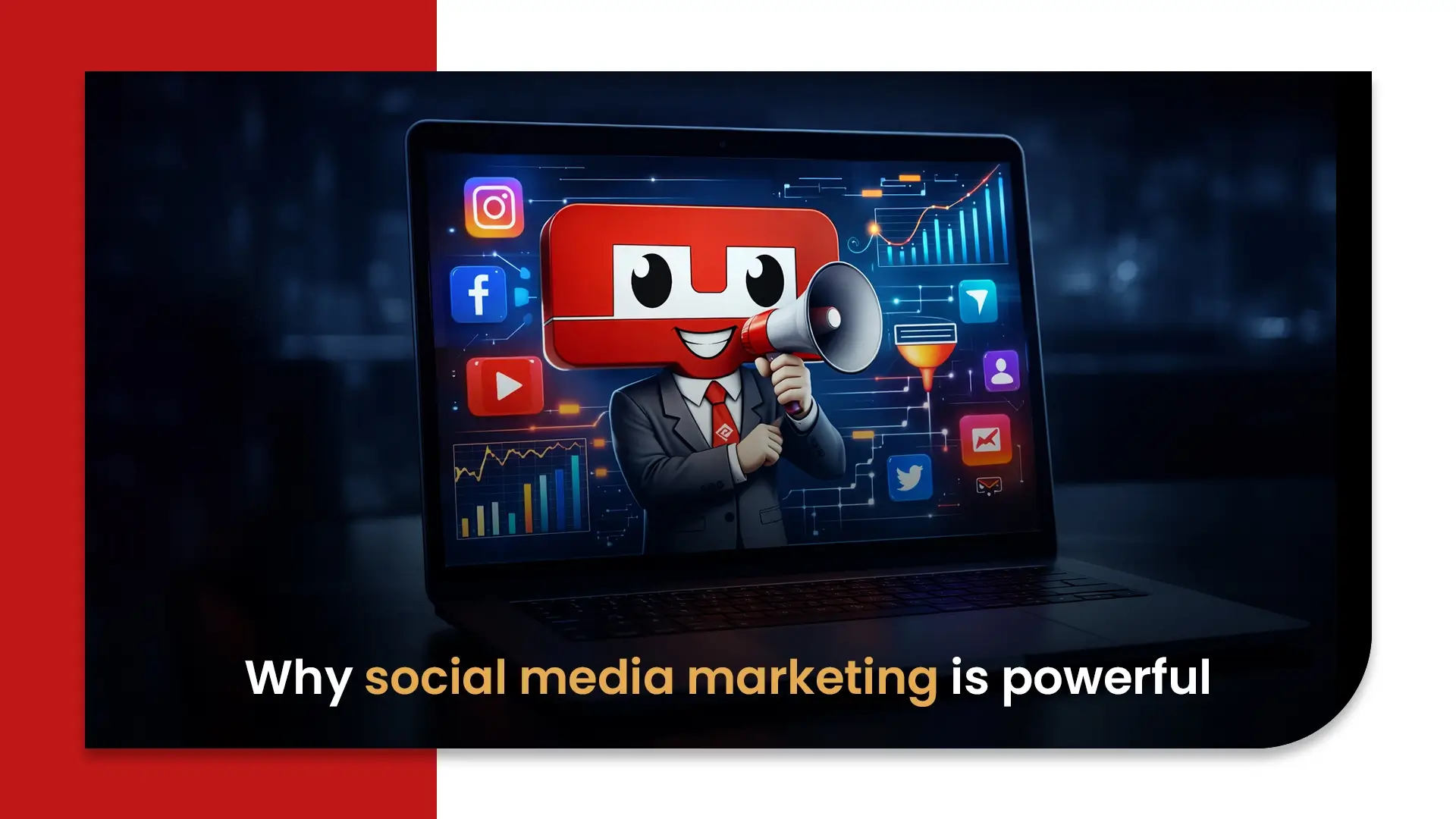
Why Social Media Marketing Matters for Business Growth
Scrolling habits have dramatically changed how businesses grow. Buyers often create opinions, compare options, and narrow down brands long before they go to a website or contact sales. The buyer’s journey has moved away from search engines, websites, and into social feeds, community discussions, and social interactions. Brands that treat social media platforms as strategic business channels, rather than just a place to post, are outpacing their competitors.
This is not about the latest trend; this is about how consumers’ attention, trust, and willingness to purchase now work.
What is Social Media Marketing? How Does it Work?
Social Media Marketing utilizes social networks to connect and interact with the target audience through valuable content and an established brand presence based on engendering sufficiently consistent messages to maintain an ongoing frequency of posts. All of which may be accomplished through paid means of disseminating this information.
The methods below are three complementary areas to keep in mind in developing your SMM strategy:
- Create content that has value to your target market; this may include educational, entertaining, or informative material.
- Utilize the platform’s algorithm to show your content to your audience through the social media platform’s algorithm.
- Consumer behavior signals are indicators of whether or not consumers are engaging with your offers.
The determining factor in developing your SMM strategy is utilizing the consumer’s feedback and developing your targeting, messaging, and branding as a result of the consumer engagements with your content.
Therefore, modern digital marketing social media strategies are developed by continuously learning from consumer engagement with the overall brand and the brand’s social media presence.
Why Social Media Marketing Matters for Modern Businesses
Today’s business consumers act like regular consumers when purchasing products. They will investigate your public image, seek feedback from other users, compare your offerings to those of your competitors, and take the time to gauge your brand’s trustworthiness, all before submitting a contact request for your company’s products or services.
The latest statistics show how social media marketing will increase your company’s reputation by showing:
- 71% of potential business consumers examine the social media presence of businesses before contacting them.
- Approximately 50% of B2B decision-makers believe that social media has a major impact on which vendors they choose.
- Businesses that promote themselves via social media establish themselves as reputable faster than their competitors who do not.
These changes are how social media improves businesses and their brands by doing much more than generating visibility for them. Social media creates trust, reputation, and purchasing confidence.
Social Media and Brand Visibility
Traditional methods of generating visibility for a business or brand do not work as well as social media does because traditional methods are not flexible! Social media provides many opportunities for businesses to create multiple impressions about their brands in different ways.
Building visibility with social media occurs through:
- A consistent message that tells your brand’s story on all social networks.
- Repetition of your brand message in many different formats.
- Audience-driven amplification by their shares.
Marketers are making one big shift from time-based to continuous presence on social networks. The brands that consistently engage and produce social content will be known to consumers when it comes time to buy.
Social Media as a Tool for Building Brand Loyalty and Trust with Customers
Social media is not just about “likes” or “followers.” It should be measured based on how many opportunities people have to interact with the brand. The brands people are engaged with on social media develop more trust because of their ability to interact with them, versus brands with which they have had no engagement.
Trust builds through:
- Prompt replies and real conversations.
- Transparency in comments, even when criticism appears.
- Educational content that solves problems without selling immediately.
Industry experts agree that the comment section is the new place for testimonials. Companies that are looking to build a reputation rely heavily on how their customers interact with brands.
Lead Generation and Sales Through Social Media Marketing
In recent years, social media lead generation has evolved. More advanced approaches are also being used for lead capture, such as organic social media, remarketing, and social selling through conversations.
Some examples of effective strategies are:
- Developing thought leadership content to capture the attention of decision-makers
- Utilizing native forms on your social media channels for easy conversion of leads
- Targeting your audience with remarketing ads based on the user’s previous clicks or social media engagement with your online content
The social media marketing benefits of employing a layered funnel approach include increasing the quality of your leads because the user has been exposed to your brand message long enough to be educated about what you offer before entering the sales funnel.
The Expense of Social Media Advertising
The benefit of social media advertising for marketers is that marketers can target their advertising at a specified audience, even though that audience has not had any prior interaction with the marketer. Businesses may examine user behavior, jobs held by users, user interests, and some cases, user intent to ensure that their advertising is being placed in front of potential users.
Cost advantages come from:
- Flexible budget allocation.
- Real-time performance adjustments.
- Creative testing without large production expenses.
Compared to mass advertising, the efficiency gap is widening. Many brands now report measuring their performance on a variety of metrics rather than solely relying on ‘reach.’ Brands also incorporate both costs incurred by the qualified customer for performance of a particular action, as well as the long-term return of their investments.
Social Media Improves Customer Loyalty to Brand
People build loyalty toward a brand according to how much exposure they have received, so, simply put, the more often they see and become acquainted with your brand, the more likely they will remain loyal to you.
Social Media positively impacts brand loyalty in the following ways:
- Consistent Branding: A company that has a consistent social image provides stability and security to their customer base.
- Celebrating customer stories and community voices.
- Offering ongoing value beyond transactions.
This ongoing relationship creates retention loops. Customers return not just for products, but for the brand experience.
Data-Driven Insights & Analytics in Social Media Marketing
One of the lesser-discussed strengths of social media strategy is the depth of behavioral data available.
Brands track:
- Content retention rates.
- Audience drop-off points.
- Conversion paths from first interaction to sale.
This data reveals what messaging resonates and what fails. Experts increasingly treat social platforms as live research labs. Every campaign becomes a learning cycle.
Organic vs Paid Social Media Strategies
Organic and paid approaches serve different purposes. Treating them as interchangeable limits results.
Organic drives:
- Authority and credibility.
- Community and conversation.
- Long-term visibility.
Paid accelerates:
- Reach and targeting.
- Lead acquisition.
- Testing of new messaging.
The most effective brands align both. Organic builds trust. Paid scales impact.
Why Businesses Look for a Social Media Marketing Company
Many Brands seek specialized partners to manage execution and strategy together. A social media marketing company in Ahmedabad focuses on helping businesses combine creative direction and performance tracking with platform expertise.
Typically, brands expect to see:
- Content planning based on the specific platform.
- Optimal performance of paid campaigns.
- Decision making backed by data.
- Reports that are associated with business outcomes.
The shift of social media from simply being an additional marketing tool to becoming a key growth channel represents the demands from companies for social media marketing to help them achieve their overall objectives.
Trends Impacting The Future Of Social Media Marketing
Companies that are part of social media marketing are already changing and evolving based on trends that will significantly impact the next phase of social media marketing.
- AI-based content planning will eliminate guesswork for brands when they are creating social media content.
- Social commerce is removing friction between the discovery of a product and the purchase of that product.
- Community-led growth will outpace traditional brand-driven messaging as the dominant way of creating social media growth.
- Short-form video will continue to attract the most attention from users on social media.
- Private communities and messaging will increasingly replace public feeds to foster deeper engagement.
Another thing that many experts mention is the fact that, in addition to creating high-quality content, brands must consistently produce content in order to generate sustainable long-term returns on their investment. Publishing frequently and using analytics will cause brands to see a compounding effect on their social media ROI.
The Expanded View of Social Media Marketing’s Place In Business
The way that people use social media has changed; brands will be judged not just by their follower count but also by their ability to influence positively, remain relevant, and add value to the sales funnel as part of their overall business strategy.
Businesses now integrate social into:
- Product launches.
- Recruitment branding.
- Investor communications.
- Customer support systems.
The integration of social media marketing into physical infrastructure demonstrates how we have evolved from just using social media to promote ourselves to creating a physical manifestation of the power of social media.
By combining social media with other forms of digital marketing, organisations within the Social media marketing company in Ahmedabad wish to align their strategies, analytics, and execution as part of an integrated system.
Concluding Take
The real value of social media is compressed time; trust is established more quickly; feedback is received in real-time; visibility compounds over time; decisions can be made quickly.
Those who just see social media as something they post on will fall behind, while those who use social media as a strategic engine to create lasting influence, build lasting customer connections, and measure their revenue impacts will be successful.
The question is not whether social media is important, but rather whether or not brands are maximising the use of social media in order to influence the way that they are perceived, create demand for their products, and build customer loyalty before their competition does.
Social media platforms have billions of active users, which gives brands massive visibility. When businesses consistently post valuable content, use relevant hashtags, and engage with followers, their reach expands organically.
Paid advertising further boosts visibility by targeting specific demographics, interests, and behaviors. Over time, repeated exposure to your brand builds recognition and trust, making customers more likely to choose your business over competitors.
Yes, social media marketing directly impacts sales. Platforms now offer features like shopping tags, in-app purchases, and direct product links that shorten the buying journey.
By using targeted ads, retargeting campaigns, influencer collaborations, and engaging content, businesses can guide users from awareness to purchase. Social proof—such as reviews, testimonials, and user-generated content—also encourages buying decisions.
Social media allows two-way communication between brands and customers. Businesses can respond to comments, messages, and reviews in real time, which builds stronger relationships.
Interactive content like polls, stories, live videos, and Q&A sessions increases participation. This engagement makes customers feel valued and heard, which strengthens loyalty and long-term retention.
Yes, social media marketing is generally more affordable than traditional advertising like TV, radio, or print media. Businesses can start with a small budget and scale based on performance.
With detailed analytics, companies can track ROI, optimize campaigns, and focus only on strategies that deliver results. This flexibility makes social media marketing one of the most powerful and cost-efficient digital marketing channels today.
The best platform depends on your target audience and business type.
Facebook & Instagram are ideal for B2C businesses, ecommerce, and local brands.
LinkedIn works best for B2B marketing and professional services.
YouTube is powerful for long-form educational and product videos.
TikTok & Instagram Reels are great for short-form, high-engagement content.
Choosing the right platform ensures better engagement and higher ROI.

What started as a passion for marketing years ago turned into a purposeful journey of helping businesses communicate in a way that truly connects. I’m Heta Dave, the Founder & CEO of Eta Marketing Solution! With a sharp focus on strategy and human-first marketing, I closely work with brands to help them stand out of the crowd and create something that lasts, not just in visibility, but in impact!

Top Digital Marketing Trends to Watch in 2026