When Your Website Speaks AI: Why LLMs.txt Might Matter
If a prospective customer asks an AI tool a very specific question about your services, and the AI answers using someone else’s content, not yours. Your carefully written pages vanish into the ether, uncredited. That’s the reality as generative-AI crawlers roam the web. Enter LLMs.txt, a file that can help your content speak clearly to AI, pointing to what matters most, protecting what doesn’t, and ultimately, giving you a shot at recognition in the AI-powered future of search.
What is an llms.txt file
Definition & purpose:
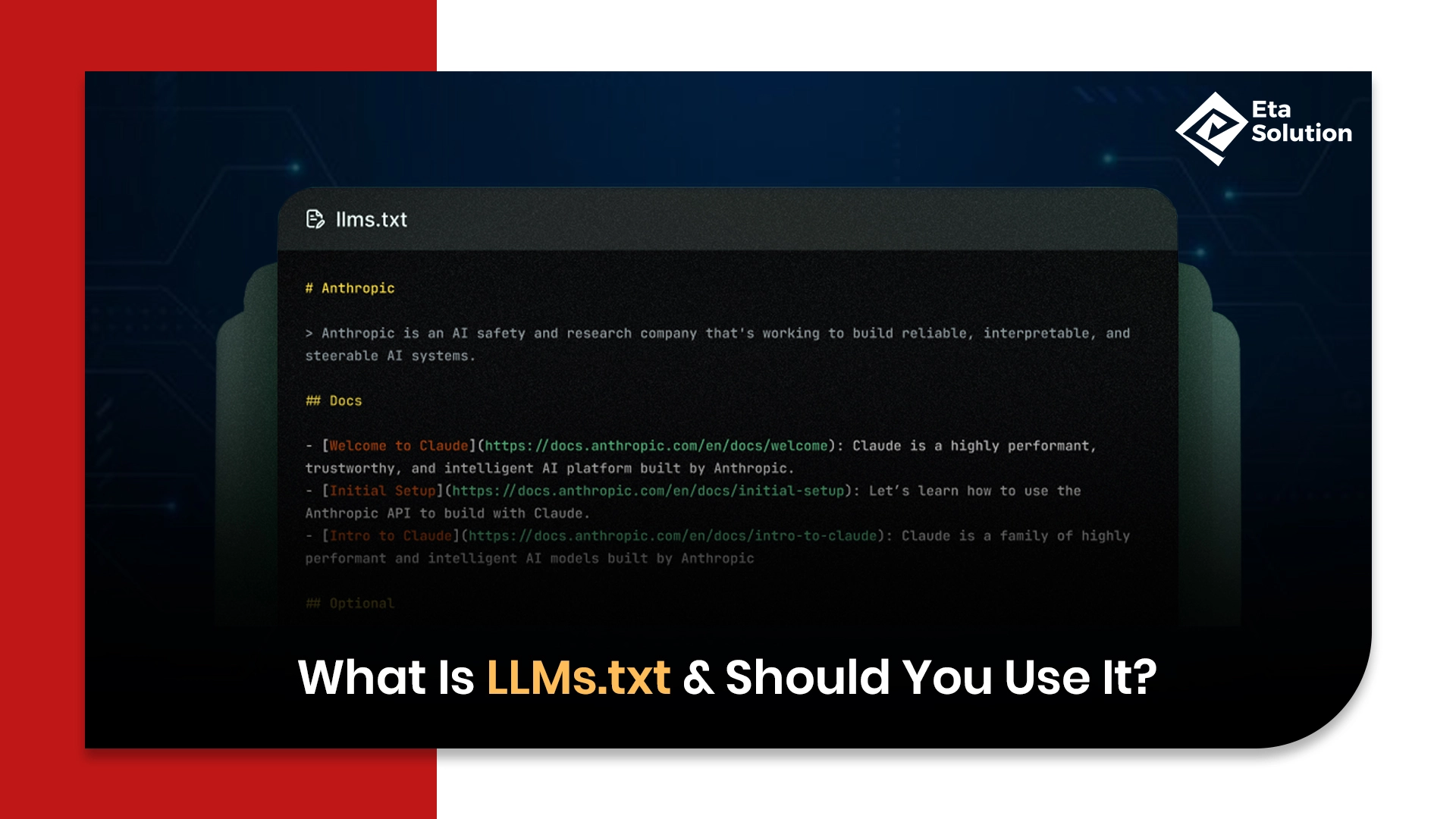
The llms.txt file represents a simplified and easily understandable Markdown file that is located at the main directory of your site. This file is not meant for regular search-engine bots but rather for the newest AI systems and generative bots that are responsible for tools like LLM-based chatbots or AI answer engines.
How it works:
Rather than giving crawl permissions, llms.txt acts like a roadmap or curated table of contents. It points AI tools toward the pages you want them to ingest blog posts, documentation, product pages, and away from parts you’d rather keep private or unindexed.
What it looks like:
Typically written in Markdown, with metadata – author, date, purpose, followed by a list of “allowed” paths or canonical pages. Optionally, there can be a more detailed companion file for richer context.
In short, it’s less of a blocker, more of a signpost telling AI, “here’s what matters, you can skip the rest.”
robots.txt vs llms.txt – Know the Difference
You might think they do the same job. They don’t.
- Traditional SEO – handled by robots.txt, which controls URLs that AI search engine rules crawlers may access. This affects indexing, ranking, and traffic.
- AI content indexing & discovery handled by llms.txt, aimed at assisting AI models in identifying high-value content, and guiding them on what to read or ignore. It doesn’t guarantee indexing, but it improves clarity and intent for AI crawlers.
Because of this distinction, many experts call llms.txt a tool for “llm website optimization” rather than a replacement for traditional SEO.
Why marketers, especially those offering Digital Marketing Services in India and worldwide, should care
The shift to generative-AI search
- As more users turn to chatbots and answer engines rather than typing keywords, visibility in AI-powered results becomes as relevant as Google ranking. Strategies like generative AI search or AI content discovery are rising fast.
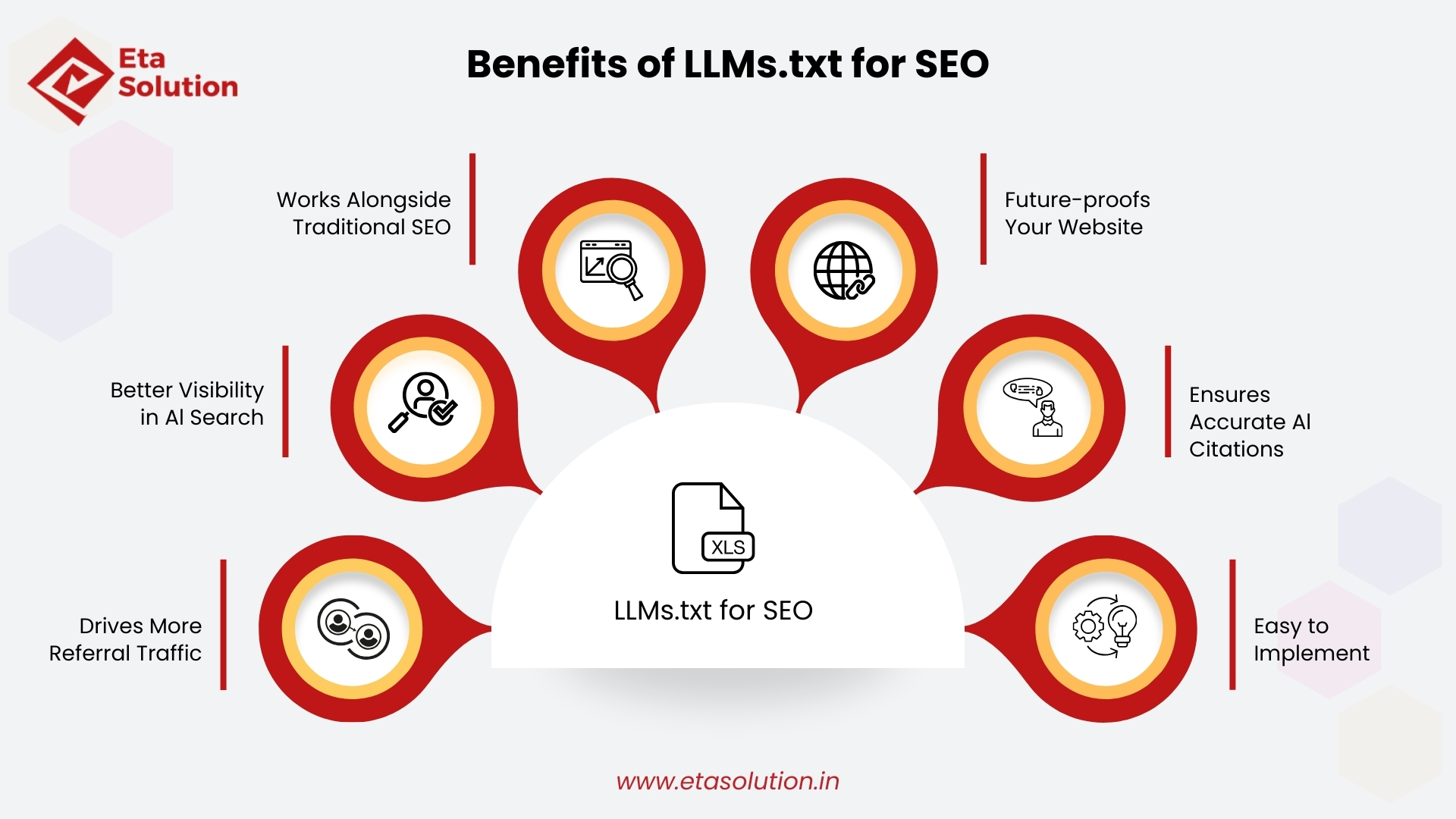
- For agencies offering Digital Marketing SEO India, embracing llms.txt gives a competitive edge. Clients’ content gets structured for both humans and machines, a dual win for discoverability and future-proofing.
Controlling AI scrapers and Clarity in AI Indexing
- With llms.txt, you decide what gets ingested, protecting proprietary assets or sensitive content from being repurposed.
- You improve the chances that AI-powered systems cite or surface the right pages (the ones you care about), rather than random or low-value parts of your site.
Low effort, potential long-term benefit
- Implementing llms.txt is straightforward. You don’t need massive redevelopment, just a file at the root, pointing to key content.
- Even if adoption among AI platforms is not universal yet, adding the file signals your brand is “AI-aware,” which could matter when generative-AI tools increasingly influence content visibility.
Current Limitations and Skepticism
- No major guarantee: As of now, many established AI providers do not officially support llms.txt. That means even if you publish it, there’s no guarantee your content will be prioritized or respected.
- Voluntary compliance: Machine learning crawlers may choose to ignore the file. The standard is still emerging.
- No direct SEO/traffic boost: Unlike traditional SEO, which affects search engine rankings, llms.txt does not guarantee better ranking or traffic. Its value lies in AI-visibility and content control.
Because of these uncertainties, some in the marketing world call llms.txt more of a “future hedge” than a must-have today.
Pro Tips if You’re Considering llms.txt for Your Site
- Place the file at the root of your domain: https://yourdomain.com/llms.txt, just like robots.txt.
- Keep the format clean, Markdown, with easy-to-read sections, clear headings, and links to canonical pages.
- Use llms-full.txt if you want to provide more detailed content summaries or structured exports for AI consumption.
- Review & update it whenever you publish major content, new services, blogs, or product pages, so your AI roadmap stays relevant.
- Combine it with good traditional SEO. Don’t expect llms.txt to replace robots.txt, sitemaps, site structure, or backlinks. Think of it as an “AI-SEO layer,” not a substitute.
AI-Ready Website & Emerging AI SEO Trends
The rise of generative engines changes how content is discovered and consumed. Traditional search engines served pages in ranked lists. Generative AI serves synthesized answers often without sending users to the original site. That means content owners could lose both recognition and control.
Using llms.txt, you get a chance to:
- Influence which content gets ingested and how it’s interpreted by AI
- Protect sensitive or proprietary material from indiscriminate scraping
- Align your site with AI crawling guidelines and future-facing AI web crawling standards
For agencies offering Digital Marketing Services in India, this signals adaptability, a service differentiator in a world where “AI-ready website” may soon be the norm rather than optional.
So – Should You Use llms.txt?
In case you manage a website that features valuable content such as blogs, case studies, white-papers, product/service pages, and you are interested in attribution, visibility, or control in the age of generative AI, then the answer is yes: the low cost and minimal effort justify having an llms.txt file.
If you are only using traditional SEO methods and have no content that needs to be protected, then you can decide not to create an llms.txt file, but you should still monitor the AI-driven discovery trend.
At the end of the day, putting llms.txt on your site is less about the immediate traffic that you might get and more about making sure that your content is visible, credited, and safe as the web is changing to an AI-powered knowledge graph.
It probably will not change traffic significantly from one day to the next, but in trust and control, which are the currencies that matter, will be the case in the long run.
Directly, no. But it can improve content protection and data governance, indirectly benefiting your overall digital strategy.
It’s recommended if you want to control how AI models use your content or protect data from unauthorized AI scraping.
Not yet. Support varies across AI companies, but adoption is growing as the need for transparency increases.
No. Robots.txt controls search engine crawlers, while LLMs.txt focuses on AI/LLM-specific crawlers and data usage permissions.
It typically includes allow/disallow rules, crawl limitations, and instructions specific to AI-based models or data usage.

What started as a passion for marketing years ago turned into a purposeful journey of helping businesses communicate in a way that truly connects. I’m Heta Dave, the Founder & CEO of Eta Marketing Solution! With a sharp focus on strategy and human-first marketing, I closely work with brands to help them stand out of the crowd and create something that lasts, not just in visibility, but in impact!

Omnichannel Marketing Strategies for eCommerce Brands

Facebook Ads for Local Businesses: A Complete Guide