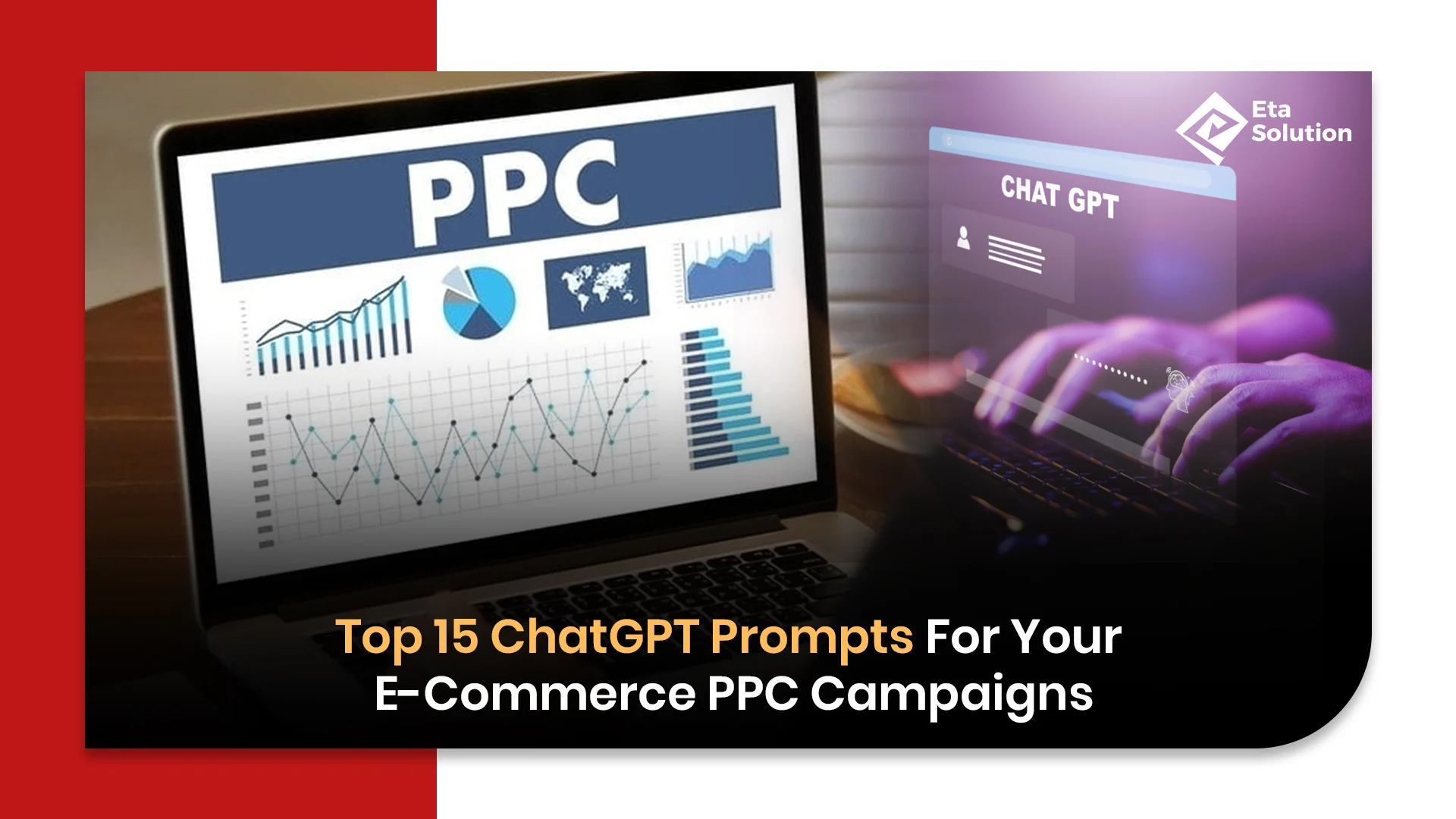
Imagine your ad spend not just churning clicks but predictably generating sales. That’s the promise when you pair legacy paid-media know-how with modern prompt craft. For an Ecommerce Marketing Agency operating in a global campaign world, the difference between generic and precision prompts can mean tens of thousands of dollars in wasted spend or saved.
Why this matters now
- In 2025, more than 90 % of advertisers are using some form of AI for PPC management.
- Research shows automation and AI-powered ad creation are top trends in paid search.
- Yet many campaigns still leak value because the “how to ask the tool” part is weak. According to one review, over a third of PPC budgets are spent on ineffective channels.
So, if you’re a brand or a leader overseeing ad spend, mastering smart prompt frameworks is a competitive edge.
What these prompts cover
We’ll walk through 15 high-impact prompts you can plug into your workflows for:
- Keyword and audience discovery
- Ad copy generation and optimisation
- Campaign structure & bidding ideas
- Performance analysis and automated iteration
Each prompt ties in “ChatGPT prompts for PPC” and reflects how “AI for PPC marketing”, “eCommerce ad copy prompts”, “ChatGPT for Google Ads”, “PPC automation ideas”, and similar themes integrate.
And yes, a section mentions how an Ecommerce Marketing Agency in Ahmedabad could use this globally.
How an Ecommerce Marketing Company Gets World-class
For a specialist like an Ecommerce Marketing Agency in Ahmedabad working with US-based clients, your differentiator becomes deep prompt design + campaign architecture. Use “smart PPC campaign setup” and “AI-driven ad strategy” not just as buzzwords but as deliverables.
Here are two real-life relevant facts:
- One global e-commerce brand reported up to 25% improvement in click-through rates after applying AI-generated dynamic ad assets in Google’s ecosystem.
- In the B2B SaaS space, 77.5% of marketers use AI for ad copy creation.
Your agency can stand out by anchoring services around “automated PPC copywriting”, “ad optimisation with AI,” and “ChatGPT ad ideas”.
The 15 Best Prompts You Can Use To Day
Every one of these prompts can be tweaked to fit your vertical, assortment of products to sell, or campaign’s goal. You can also save yourself the effort of writing the brackets like [PRODUCT], [AUDIENCE], and [GOAL] and just put your clients’ context in the prompts. No BS words, just directional indicators.
1. Prompt for audience personas & pain-points
“I run an e-commerce campaign for [PRODUCT CATEGORY]. Create three audience personas (name, age, behaviour, buying triggers). For each persona, list their top 5 pain-points and the 3 most relevant keywords they’d likely search.”
Use this to build targeting layers or asset groups.
2. Prompt for keyword clusters
“As part of a Google Ads account for [PRODUCT], generate 40-50 keyword ideas. Categorise into ‘high-intent (buy)’, ‘consideration (compare)’, and ‘education (learn)’. Indicate estimated search volume range, competition level, and suggested negative keywords.”
This contributes to your “smart PPC campaign setup”.
3. Prompt for ad copy variations
“Write 10 different responsive search ad headlines (max 30 characters) and 5 descriptions (max 90 characters) for [PRODUCT]. Each version should highlight a unique benefit, a promotional angle, or a trust signal.”
Integrates “eCommerce ad copy prompts”.
4. Prompt for display-/video secondary creative
“Generate script outlines for two 15-second video ads promoting [PRODUCT] to [AUDIENCE]. Write taglines, key frames (text on screen), and final call-to-action. Provide optional variations emphasising urgency vs. value.”
5. Prompt for audience-behaviour segmentation insights
“Analyse past campaign data where available (e.g., [CHANNEL], [COUNTRY], [AUDIENCE SEGMENT]) and suggest three new micro-segments. Explain why each is likely to improve conversion rate or reduce cost per acquisition.”
This touches “AI tools for advertisers” and “performance marketing prompts”.
6. Prompt for negative keyword mining
“Look at this list of search terms [INSERT TERMS] and identify which ones should be negative keywords for a campaign selling [PRODUCT]. Provide reasoning and alternative keywords to test instead.”
7. Prompt for landing page optimisation feedback
“Review the landing page copy for [PRODUCT URL] (paste copy here). Provide 8 suggestions to improve clarity, remove friction, and increase conversion rate, based on best practices for e-commerce.”
8. Prompt for bidding & budget strategy
“Suggest an optimal bidding and budget allocation strategy for a new PMax/Google Ads campaign for [PRODUCT] with a goal of ROAS > 4 and a monthly budget of $10k. Include timing (dayparts), device split, and audience-signal recommendations.”
This is “PPC automation ideas” territory.
9. Prompt for competitor ad-copy and angle reverse-engineering
“Assume competitor A and B run ads for [PRODUCT CATEGORY]. Based on public search ads or creatives, hypothesize their value propositions. Then draft three counter-angles our brand can use to differentiate.”
10. Prompt for seasonal/promotional campaign themes
“Plan a campaign around [PROMOTION, e.g., ‘Back-to-School’ or ‘Holiday Sale’] for [PRODUCT]. Generate three thematic hooks, associated ad copy, targeting ideas, and urgency messaging.”
11. Prompt for performance-analysis dashboard description
“Outline a dashboard that tracks campaign health for [CLIENT]. Include key metrics (CTR, conversion rate, ROAS, CPA), alert thresholds, and custom computed fields that matter for e-commerce.”
12. Prompt for creative test matrix
“Create a test matrix for ad creatives for [PRODUCT]. Define 3 headlines × 2 descriptions × 2 audiences × 2 bid-strategies = 24 tests. Label each test cell with hypothesis, KPI, and expected learning.”
13. Prompt for remarketing copy-set
“Draft three sets of remarketing ad copy for users who visited [PRODUCT PAGE] but did not purchase. Each copy should address a different barrier: price, lack of trust, or maybe forgetfulness. Include CTA.”
14. Prompt for expanding geographically / internationally
“We plan to expand to [COUNTRY] for [PRODUCT]. List five cultural/behavioural insights for e-commerce consumers there, five localised keyword variations, and ad copy adjustments for localisation.”
15.Prompt for scaling & automation workflow
“Using tools such as [list your stack], describe an end-to-end workflow that uses AI to generate new ad copy, upload it into campaigns, monitor performance daily, and automatically turn off the lowest-performing assets. Specify trigger thresholds and roles/responsibilities.”
This last one brings in “AI-driven ad strategy”, “automated PPC copywriting,” and “ChatGPT marketing strategy”.
Pro Insights & Lesser-Known Trends
Because you’re writing for experts, not beginners, here are details that elevate the narrative.
- Even with AI tools, data quality matters massively. According to a recent SaaS PPC study, companies that achieved positive ROI had clear target-audience definitions, proper full-funnel measurement, and alignment between marketing and sales.
- With privacy changes and third-party cookie deprecation, many e-commerce brands are shifting to first-party data combined with AI-powered targeting.
- You’ll see a growing need to treat prompts as systems, not sentences. One stack review emphasises that most generic prompts fail because they lack business context, methodology, and decision rules.
- A lesser-publicised trend: Generative AI is layering into ad creative generation + dynamic asset groups. One 2025 review said AI-powered ad creation is now table-stakes.
Real-Life Wins & How to Talk About Them
- A mid-sized e-commerce brand using AI-generated responsive ads and dynamic creatives reported a 25% uplift in click-through rate after implementing AI ad-creation.
- In another case, 77.5% of marketers used AI for ad copy creation. That signals major adoption and expectation shifts.
- If your agency shares case-studies along these lines, “we used prompt-driven workflows, cut asset-creation time by X, improved ROAS by Y,” you build credibility.
How to Get Started
- Ensure you define the campaign objective clearly.
- Always seed your prompt with original data/context. Without context, you’ll get generic output.
- Use output from prompts as starting points, not finished ads. Always review and customize.
- Run A/B tests: many think AI output is “final copy,” don’t. Use it to generate variants.
- Regularly review performance and adjust the prompt framework itself.
- Don’t assume “AI = set-and-forget”. As automation increases, platforms are reducing visibility into data and human control.
Closing Take
If you remain comfortable churning the same ad copy, bidding logic, and segmentation templates of last year, you risk falling behind. But if you embrace prompt-driven workflows, frame them as systems, apply them with discipline, and partner them with expert human review, you give yourself an edge.
For an Ecommerce Marketing Agency in Ahmedabad running campaigns for international clients, mastering this gives you a unique value proposition: “We don’t just run ads, we engineer them with AI-assisted precision, designed for scale.”
As you integrate “ChatGPT prompts for eCommerce”, “AI marketing prompts”, “ChatGPT for Google Ads”, and other elements into your strategy, ask yourself: Will your next campaign spend like last year, or will it perform smarter?
Clear, specific prompts that include your product details, target audience, tone, and marketing goals produce the best PPC-related outputs.
Yes. It can generate multiple variations of ad copy, headlines, offers, and angles for you to test and compare.
Yes. It can create tailored content for Google Ads, Bing Ads, Meta Ads, TikTok Ads, Pinterest Ads, and more.
Not necessarily. ChatGPT can handle many tasks, but pairing it with PPC tools like Google Keyword Planner, SEMrush, or Ahrefs can enhance accuracy.
Definitely. It can explain bid strategies, metrics, match types, audience segments, and campaign structures in simple terms.

What started as a passion for marketing years ago turned into a purposeful journey of helping businesses communicate in a way that truly connects. I’m Heta Dave, the Founder & CEO of Eta Marketing Solution! With a sharp focus on strategy and human-first marketing, I closely work with brands to help them stand out of the crowd and create something that lasts, not just in visibility, but in impact!

Google Ai Content Guidelines
How User Intent Drives Modern Search Strategies