Complete Guide to the New AI Feature in Google Search Console
Google didn’t announce this update with fireworks. But if you’ve been working inside Search Console lately, something feels different. The data isn’t just sitting there anymore. It’s nudging you. Pointing things out. Almost like it’s trying to do half your job. That’s not accidental.
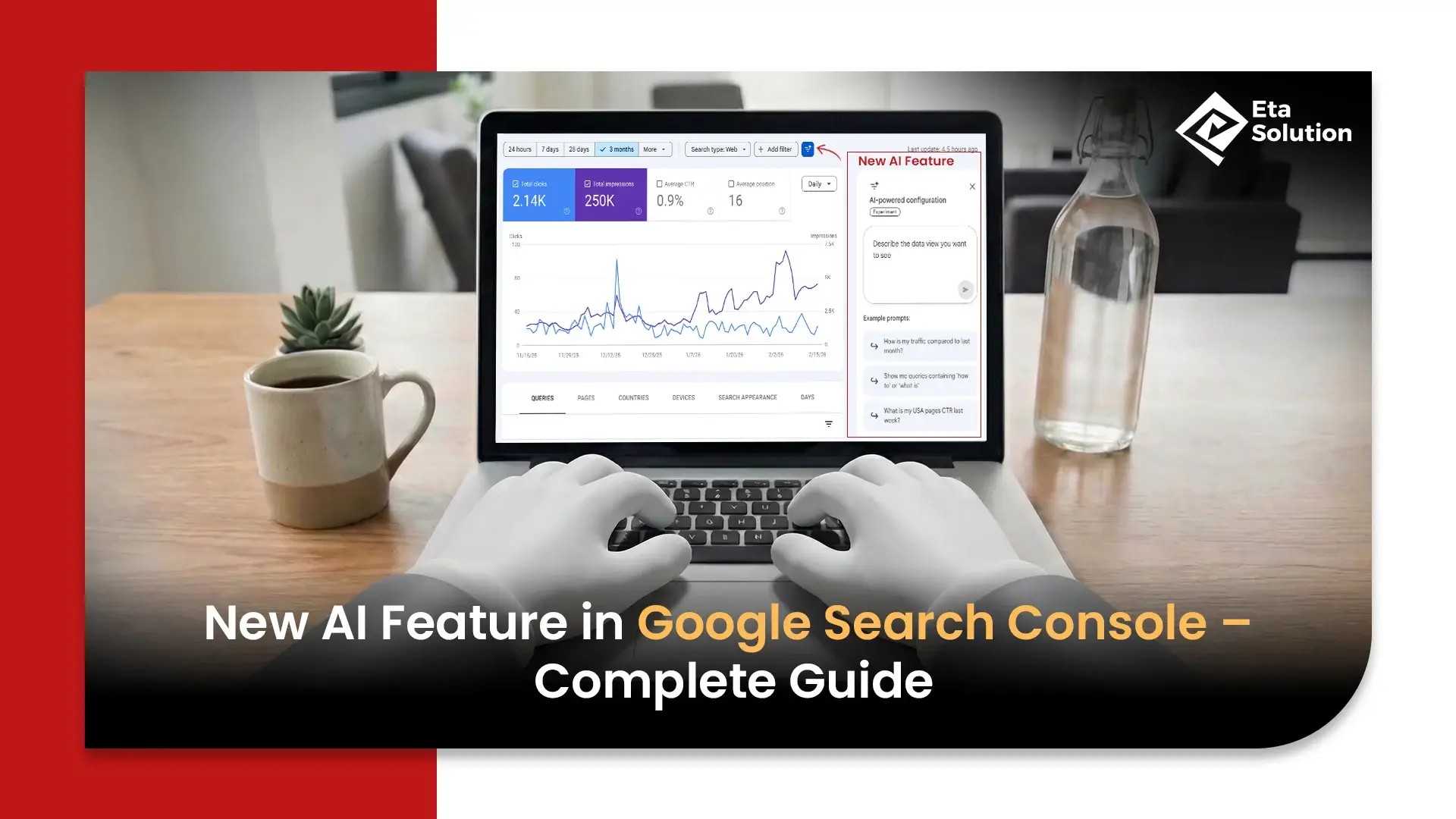
With the latest evolution of the Google Search Console AI feature, Google is quietly shifting SEO from manual analysis to guided decision-making. And if you’re still using it like the old version, you’re missing the point. Let’s get into what actually changed and why it matters.
What Is the Google Search Console AI Feature?
The Google Search Console new update introduces AI layers that interpret your search data instead of just displaying it.
Earlier, GSC worked like a reporting dashboard. You pulled numbers, applied filters, and tried to figure out patterns yourself. It demanded time and, frankly, patience most teams don’t have.
The GSC AI update 2026 currently reduces the time needed to complete that procedure. The system creates automated reports that analyze your data throughout its operations. The system will display performance drops together with their potential causes, which you can use to identify underperforming pages instead of performing manual page assessments.
This shift matters because the tool is no longer passive. It actively participates in analysis. And that changes how fast you can move.
Why This Update Matters More Than It Looks
There’s a quiet inefficiency in most SEO teams. They spend too much time diagnosing and not enough time executing.
Recent industry data suggests that over 65% of SEO time goes into analysis rather than action. That’s a massive drag on growth.
The search analytics AI feature directly addresses this gap by reducing the effort needed to understand what’s happening.
Instead of digging through multiple filters to identify trends, the AI highlights meaningful patterns upfront. It doesn’t just show that traffic dropped. It points toward where and why it might have happened.
This means teams can:
- React faster to performance changes
- Prioritize high-impact pages without guesswork
- Spend more time improving content instead of decoding data
The real value here isn’t intelligence. It’s speed.
Inside the GSC Insights AI: What It Actually Shows
The GSC insights AI layer is where the update becomes genuinely useful.
It surfaces observations that feel closer to strategy than raw data. For instance, you may see insights suggesting that a specific group of queries is gaining traction due to rising interest in a topic. But these insights aren’t random or generic.
They are driven by:
- query clustering, where related searches are grouped based on intent
- user behavior patterns, such as click trends and dwell time
- emerging search trends that indicate shifting interest
What this means in practice is that you’re no longer looking at isolated keywords. You’re seeing how topics behave.
This is a major leap from traditional tools and aligns with the rise of AI powered SEO tools that focus on interpretation rather than just reporting.
Google AI Search Performance: A Shift Toward Intent
One of the most important changes in this update is how Google AI search performance is framed.
SEO used to revolve around rankings. But rankings alone never told the full story. Now, AI helps connect performance with user intent.
For example, a page might maintain its ranking but lose clicks. Earlier, this would look confusing. With AI insights, you may discover that the content no longer aligns with what users expect when they search that query.
This introduces a more nuanced way of evaluating performance:
- Are users finding what they expect on your page?
- Is your content still relevant to evolving search behavior?
- Are competitors offering a better answer in a different format?
The update pushes you to think beyond positions and focus on relevance.
How AI Is Changing Google Search Data Analysis
The way we approach Google search data analysis is changing fundamentally. Earlier, analysis was manual and often reactive. You noticed problems after they had already impacted performance.
The integration of AI with GSC transforms operations into an active monitoring system. The AI system needs to identify patterns across multiple data sets. It identifies trends through its ability to detect seasonal spikes and sudden drops without using manual segmentation. The system provides two benefits by eliminating manual work, and it prevents critical signals from being overlooked.
The system delivers contextual guidance through its recommendations. The system offers data-driven insights that are specifically designed for your actual data. The system identifies which pages require content expansion because competing pages contain more information.
The system speeds up the process of making decisions. Teams can proceed directly to their work instead of spending time reviewing reports.
SEO automation with AI reaches its most important point. The system improves operations through its ability to eliminate operational obstacles without eliminating the need for human workers.
What Businesses Are Already Seeing
Companies that have begun to use the Google Search Console AI feature are experiencing measurable benefits.
The process of finding ineffective content has become faster because of recent changes. Teams now have the ability to detect problems through their work, which allows them to fix issues before their monthly reports arrive.
The main advantage of this system provides organizations with improved abilities to develop their content. The AI system identifies pages that approach optimal performance yet require further improvement. When businesses enhance their “almost-ranking” pages, they achieve the best return on investment results.
The current trend shows that organizations are redirecting their efforts toward enhancing existing content instead of producing new material. This approach leads to better growth outcomes because artificial intelligence simplifies the implementation process.
The Role of AI in SEO Tools Is Expanding Fast
The rise of AI in SEO tools is no longer a trend. It’s becoming the standard. Across the industry, tools are evolving to:
- predict performance instead of just tracking it
- recommend actions instead of just presenting data
- simplify workflows instead of adding complexity
Google integrating this directly into GSC raises the baseline for everyone. It means even smaller teams now have access to insights that previously required multiple tools or advanced expertise.
But it also means expectations are higher. Because when better insights are available, poor decisions become harder to justify.
Why Expertise Still Matters
Access to AI doesn’t equal expertise. A Best Digital Marketing Agency in Ahmedabad stands out not because it uses advanced tools, but because it knows how to interpret and act on the insights those tools provide. AI can highlight problems. It can even suggest directions.
But it cannot fully understand:
- Business context
- Customer psychology
- Brand positioning
Human expertise continues to maintain its essential function at that location. The real advantage lies in combining AI-driven insights with strategic thinking.
Search Console Enhancements You Might Have Missed
Multiple Search Console enhancements extend beyond AI to create better user experience improvements.
The new query grouping system provides better results because it lets users see how different search terms connect with each other. The system provides special value because it helps users create content and find related topic groups.
The system now provides better filtering abilities which let users execute detailed investigations without the need to send data outside the system. The system now provides better filtering abilities which let users execute detailed investigations without the need to send data outside the system.
The new indexing insights now deliver better results because they enable teams to find technical problems with greater speed.
The platform has received multiple updates, which appear minor but actually enhance its overall functionality.
Google Ranking Insights AI: What It Means for Strategy
The introduction of Google ranking insights AI signals a shift in how rankings should be interpreted. Rankings are no longer static indicators of success.
They are influenced by:
- Changing user intent
- Evolving search behavior
- Dynamic SERP features
This means that holding a top position doesn’t guarantee consistent traffic. Strategies now need to focus on maintaining relevance over time. Content must evolve alongside user expectations.
SEO is becoming less about reaching a position and more about sustaining performance.
How Smart Teams Are Using This Update
The most effective teams are not treating this update as just another feature. The teams use the new feature to enhance their current operational processes.
The team conducts weekly performance assessments, which they consider more effective than their previous monthly assessment method. The team uses this method to achieve quick updates, which enable them to create more flexible planning approaches.
The organization uses GSC data together with internal metrics, which include conversion rates and user activities, to produce better decision-making results. The system changes GSC into a main resource for decision-making instead of existing solely as a tool for generating reports.
The New Competitive Edge
The performance gap between standard agencies and top-performing agencies will begin to expand.
A Best Digital Marketing Agency in Ahmedabad will use this update to move faster, refine strategies continuously, and focus on execution.
Meanwhile, others will continue using it as a basic reporting tool. The difference won’t be access to data. It will be how effectively that data is used.
Final Thoughts
The GSC AI update 2026 isn’t just a feature upgrade. It’s a shift in how SEO works. You now have access to:
- Clearer insights
- Faster analysis
- More actionable data
The tools you use will not produce results until you make decisions about their implementation. Your SEO strategy needs to become more effective because your current methods show unresponsiveness to their needs. You are not utilizing the existing resources because you have not reached their complete potential.
The AI feature improves SEO by automatically detecting patterns in search queries, clicks, impressions, and rankings. It can highlight underperforming pages, suggest keyword improvements, and recommend content updates. By using these insights, website owners can make data-driven decisions that lead to better rankings, increased organic traffic, and improved user engagement.
Google typically rolls out new features in phases. While the AI feature may be available to some users initially, it is expected to become accessible to all Google Search Console users over time. You can check your dashboard or official Google updates to see if the feature has been enabled for your account.
No, one of the main advantages of this AI feature is its user-friendly design. It simplifies complex SEO data into easy-to-understand insights and recommendations. Even beginners can use it to identify issues and improve their website performance, while experienced users can leverage it for deeper analysis and optimization strategies.
Yes, the AI feature can assist with keyword research by identifying new keyword opportunities based on your website’s existing data. It may suggest related search queries, long-tail keywords, and trending topics that can help you expand your content strategy and target more relevant traffic.
The insights are based on real-time data collected from Google Search, making them highly reliable. However, like any AI system, the recommendations should be used as guidance rather than absolute rules. It’s always best to combine AI insights with your own SEO knowledge and strategy for optimal results.

What started as a passion for marketing years ago turned into a purposeful journey of helping businesses communicate in a way that truly connects. I’m Heta Dave, the Founder & CEO of Eta Marketing Solution! With a sharp focus on strategy and human-first marketing, I closely work with brands to help them stand out of the crowd and create something that lasts, not just in visibility, but in impact!