How Do Search Engines Work? Crawling, Indexing & Ranking Process
Search engines receive an enormous number of searches every second. Google alone performs over 99000 searches each second and will continue to do so. This is not an error, but is indeed the exact total of the number of searches Google is doing at this very moment in time. However, the majority of the internet never appears in any search results. This is the hard truth of search engines and the lack of visibility of your website.
Many websites aren’t visible in search results because of poor content; most are never discovered by the search engine at all. If you want to make your site visible in search engine results, it is critical to learn how search engines work today from an engineer, SEO professional, or algorithms team.
This book will break down the three core functions of crawling, indexing, and ranking as performed by search engines and provide practical, real-world examples of how to apply the recommendations in your business decisions.
Understanding How Search Engines Operate
Search engines have been a tremendous success over the last couple of decades; because they are essentially a digital library, search engines can provide access to an ever-growing amount of information. Search engines work as a comprehensive set of decision systems that constantly update themselves based on user behavior. The function of search engines is not to store information, but to evaluate the information and determine which is worthy of being shown to a user.
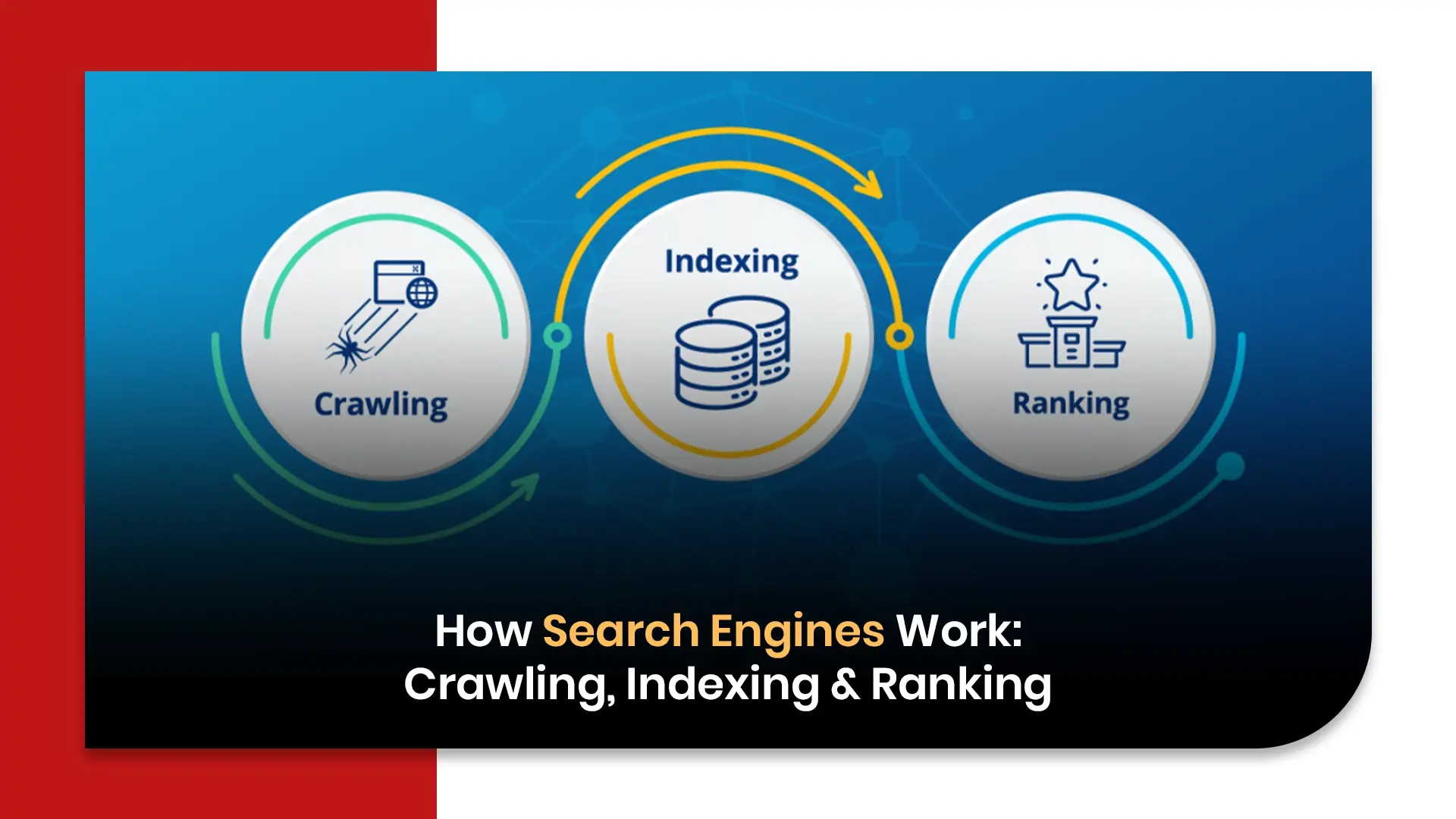
All search engines perform the same tasks in a specific order: crawl to find content, index to understand and store the content, and rank to decide when and how to display the content. Missing one of these three functions means that the other two functions will never be relevant to your website. This is why many organizations invest time and resources into learning and implementing the essential principles of SEO that extend way beyond keywords and the frequency of blog posts.
What Is Search Engine Crawling
Search engine crawling is the discovery phase.
Search engines send automated programs, often called search engine bots, to find new and updated pages across the web. These bots do not browse like humans. They move through links, sitemaps, APIs, and structured data.
Here’s a lesser-known fact most businesses miss: Google does not crawl every page equally.
Internal data shared at Google Search Central events shows that crawl budget is actively allocated based on:
- Site authority and trust signals
- Server performance and response time
- Internal linking depth
- Frequency of meaningful updates
If your site is slow, bloated, or poorly structured, crawling slows down, even if your content is strong.
How Search Engine Bots Discover Web Pages
Search engine bots find pages through multiple discovery paths, not just links.
The most reliable discovery methods today include:
- XML sitemaps that are clean and updated
- Strong internal linking from high-value pages
- External links from authoritative domains
- Structured data that signals page purpose
An interesting trend from enterprise SEO audits in 2024 shows that JavaScript-heavy websites lose up to 30 percent of crawl efficiency when rendering is poorly handled. Bots can render JavaScript, but they do it selectively.
This is where crawling and indexing SEO overlap with technical SEO fundamentals in a very real way.
What Is Search Engine Indexing
Indexing is where most content quietly fails.
Once a page is crawled, search engines decide whether it deserves a place in their index. Indexing is not automatic. It is selective.
During search engine indexing, algorithms evaluate:
- Content uniqueness and intent clarity
- Topical relevance within the site
- Content depth compared to similar pages
- Technical accessibility and canonical signals
Industry data from large-scale SEO platforms shows that 15 to 20 percent of crawled pages never get indexed. Common reasons include duplication, weak intent alignment, or unclear topical focus.
If a page is not indexed, it cannot rank. Period.
How Search Engines Store and Organize Indexed Data
Search engines do not store pages as they appear visually.
They break content into entities, topics, relationships, and signals. Think concepts, not pages.
Modern indexing systems organize data based on:
- Topic clusters and semantic relationships
- Entity recognition like brands, people, locations
- Content freshness and historical performance
- Engagement patterns across similar queries
Google’s move toward passage indexing and entity-based retrieval means a single paragraph can rank independently if it answers a query better than an entire page elsewhere.
This is why shallow content fails even when it is technically sound.
What Is Search Engine Ranking
Search engine ranking is the decision phase.
When a user searches, algorithms evaluate thousands of indexed signals in milliseconds to determine which results deserve visibility.
Ranking is query-dependent. The same page may rank well for one search and not appear at all for another.
Search engine ranking today is less about static optimization and more about intent satisfaction.
Key Ranking Factors Used by Search Engines
Ranking factors explained simply is rare, so here is the practical version without the fluff.
Search engines currently prioritize:
- Clear alignment between query intent and content intent
- Demonstrated topical authority, not just keywords
- Page experience including speed, stability, and usability
- Trust signals from links, brand mentions, and user behavior
According to leaked API documentation analyzed by SEO researchers in 2024, user engagement signals are used more heavily for re-ranking than initial ranking. This means performance after publication matters as much as initial optimization.
This is where many businesses underestimate ongoing SEO effort.
Role of Algorithms in Search Engine Results
The Google search algorithm is not one system. It is a layered stack of systems.
Core updates adjust how signals are weighted. Helpful Content updates assess value. Spam systems filter manipulation. Machine learning models refine results continuously.
One insight shared at recent SEO conferences is that algorithms now evaluate content creators, not just content. Author signals, brand credibility, and historical accuracy influence trust.
This is why generic content sites lose visibility while expert-led brands gain ground. An experienced SEO company in Ahmedabad will focus on diagnostics first, execution second, and reporting last. That order matters more than most realize.
Common Issues That Affect Crawling, Indexing, and Ranking
Most visibility problems are structural, not creative.
The most common issues include:
- Orphan pages with no internal links, reducing crawl priority
- Poor canonical usage causing indexing confusion
- Thin content created only for keywords
- Over-optimized pages triggering quality filters
Many high-performing brands discovered in auditing their real world that 40% of their content competes internally amongst themselves, hurting the overall strength of the ranking.
Many of these content issues can often be improved more quickly through the process of fixing the issue than through the creation of new content.
Improve the Website’s Visibility in Search Engines
The goal for improved visibility is not by way of “hacks.” It is about alignment.
Strong SEO strategies focus on:
- Building content around real search intent, not assumptions
- Structuring sites so bots and users navigate easily
- Updating high-performing pages instead of endlessly publishing new ones
- Treating SEO as a product system, not a campaign
Many businesses in competitive markets turn to a specialized SEO company in Ahmedabad when scaling becomes complex and internal teams hit technical limits. The key is choosing partners who understand crawling behavior, indexing logic, and ranking systems as one ecosystem, not isolated tactics.
Where This Leaves Business Leaders
Search engines are no longer passive tools. They are active evaluators.
If your website is not built to be understood at every stage of crawling, indexing, and ranking, you are competing with one hand tied behind your back.
The companies winning today are not chasing algorithms. They are aligning with how search engines actually think.
And if you are relying on outdated SEO playbooks while competitors adapt with help from an experienced SEO company in Ahmedabad, the gap will not close on its own.
The real question is not whether search engines can find your content.
It is whether they believe it deserves to be seen.
Search engines rank pages based on hundreds of signals, including keyword relevance, content depth, backlinks, mobile-friendliness, page speed, HTTPS security, and user engagement metrics like click-through rate and dwell time.
The time varies depending on website size, crawl budget, internal linking, and content quality. New pages can take anywhere from a few hours to several weeks to be crawled and indexed, depending on how often search engines visit the site.
Search engine bots are automated programs that browse the web to discover pages. Examples include Googlebot and Bingbot. They follow links, read content, and collect data to help search engines build and update their index.
Crawl budget refers to the number of pages a search engine is willing to crawl on a website within a given time. Optimizing crawl budget is important for large websites to ensure important pages are crawled and indexed efficiently.
Keywords help search engines understand the topic of a page. They are not used during crawling but are crucial for indexing and ranking, as they help match user queries with relevant content.

What started as a passion for marketing years ago turned into a purposeful journey of helping businesses communicate in a way that truly connects. I’m Heta Dave, the Founder & CEO of Eta Marketing Solution! With a sharp focus on strategy and human-first marketing, I closely work with brands to help them stand out of the crowd and create something that lasts, not just in visibility, but in impact!

Omnichannel Marketing Strategies for eCommerce Brands

Facebook Ads for Local Businesses: A Complete Guide