Google AI Mode Explained: Impact on Search, SEO & Traffic
Search didn’t quietly evolve this time. It shifted its center of gravity.
If you have noticed search results answering questions before users even think of clicking, you are not imagining things. Google AI Mode is not another cosmetic update. It is a structural change in how information is gathered, interpreted, and delivered. And unlike Google AI search updates, this one doesn’t reward volume, clever hacks, or surface-level optimization.
It rewards authority, clarity, and intent alignment.
For business leaders and marketers, the uncomfortable truth is this: search is no longer a traffic channel first. It is becoming a decision-influence layer.
Let’s understand what Google AI Mode is, how it differs from previous generations of Google AI, and what that means for brands that compete with Google AI in search.
What is Google AI Mode?
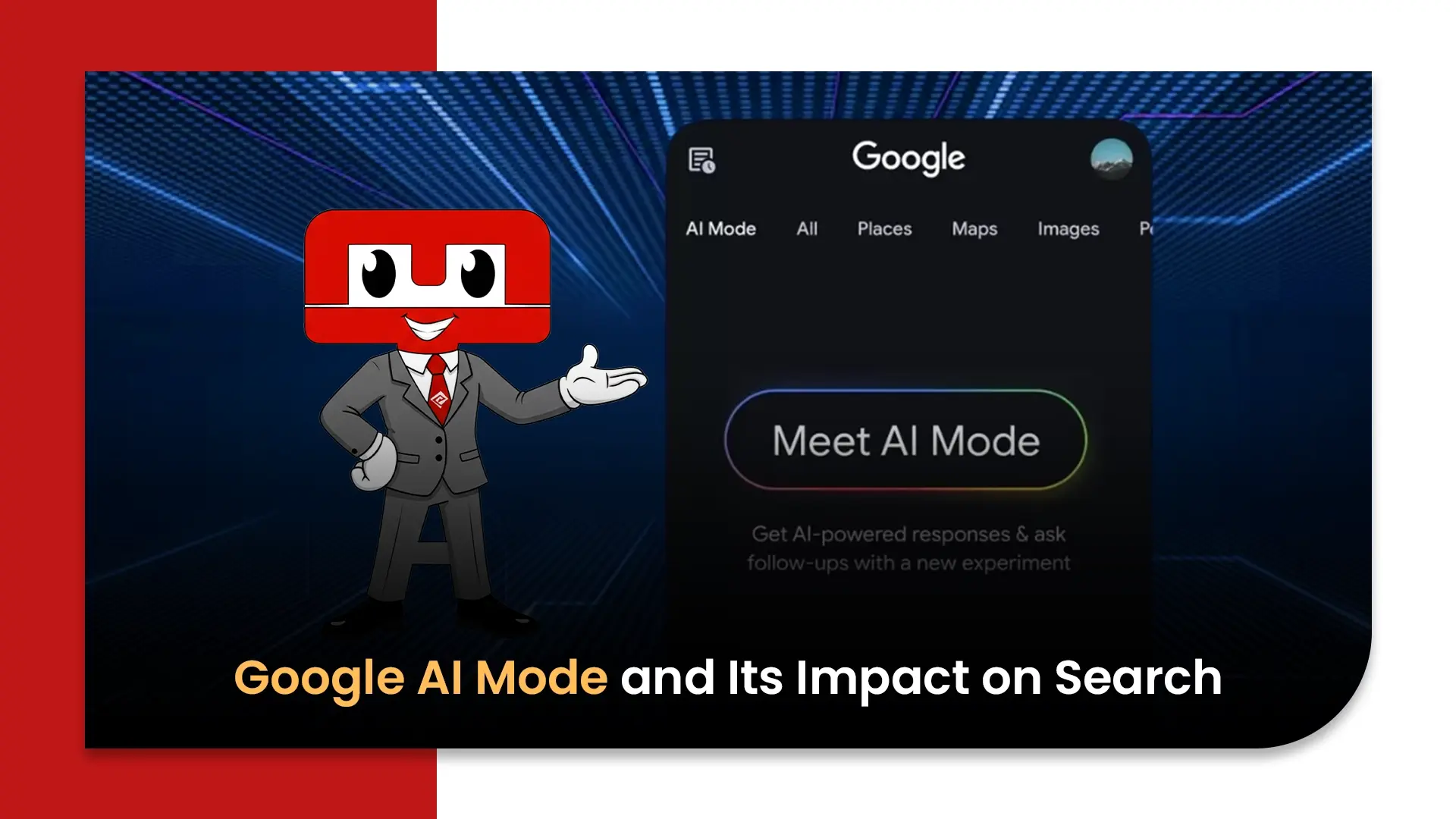
Google AI Mode is a new way to use AI in a search experience in the future, where AI interprets search queries and generates responses based on information collected across multiple sources, formatting its response directly on the SERP page.
In this new experience, Google lists links and provides the user with the tools to find the answer; with Google AI Mode, it’ll now:
- Understands complex, multi-layered queries
- Pulls context from across the web
- Generates structured answers using generative AI
This is not a test feature anymore. It is part of Google’s broader move toward search engine AI, where results are designed to solve problems, not just surface pages.
According to internal disclosures from Google’s Search team, AI-powered experiences already influence more than 40 percent of complex queries, especially in B2B, finance, healthcare, and technology-related searches. That percentage is quietly growing.
How Does Google AI Mode Differ From AI Overviews?
AI Overviews were the warm-up act. Google AI Mode is the main performance.
AI Overviews summarize content at the top of the page, but the traditional search layout still exists underneath. AI Mode goes further. It reframes the entire search experience around AI-driven synthesis.
Here’s the practical difference marketers should care about:
- AI Overviews summarize existing rankings
- Google AI Mode re-evaluates which sources deserve visibility in the first place
In AI Mode, being ranked number one does not guarantee visibility. Being useful, trusted, and contextually relevant does.
This is why many brands are seeing stable rankings but declining clicks. The rules underneath the surface have changed.
What Does AI Mode Look Like?
Visually, AI Mode is cleaner and more assertive.
Users see:
- A conversational response block
- Clear sub-sections answering follow-up questions
- Source citations embedded contextually, not listed equally
What’s easy to miss is that citations are selective. The Google search engine is now utilizing fewer sources of information but depending more on those same sources to provide accurate information to its users.
According to preliminary data collected using enterprise-level SEO platforms, search results generated through the use of artificial intelligence (AI) typically quote between thirty and fifty percent less than traditional search results. This indicates that the competition has become increasingly competitive, although the amount of impressions appears to be strong.
How does Google AI Mode Work?
In order to perform these functions, Google AI Mode uses large language models in conjunction with the current Google Index and the Ranking Algorithms. To describe it simply, Google AI Mode does the following three things simultaneously:
- Interprets user intent beyond keywords
- Evaluates topical authority across related content
- Generates responses based on trust-weighted sources
This is where AI in SEO becomes real. Pages are no longer judged in isolation. Google evaluates how well your content fits into a broader knowledge ecosystem.
Brands publishing fragmented, one-off articles are losing ground. Brands building depth around a topic are gaining disproportionate visibility.
How Do You Access Google AI Mode?
Access depends on location, query type, and Google’s ongoing rollout strategy.
Most users encounter AI Mode automatically when searching complex or comparative queries. There is no separate toggle for many regions anymore. Google decides when AI-powered search is “helpful enough” to replace traditional results.
For marketers, the takeaway is simple: opt-out is not an option.
How Does Google SGE Impact Search?
This is where things get uncomfortable.
1. A Shift in How Content Is Searched and Discovered
Search is no longer about discovering pages. It is about extracting insights.
Users are spending more time reading synthesized answers and less time navigating websites. Google’s own data suggests that follow-up queries are increasing, while outbound clicks per session are declining.
This fundamentally changes how AI search results influence buying decisions.
2. Reduced CTR
Multiple industry studies now show CTR drops ranging from 18 to 35 percent on informational queries affected by Google generative search.
This does not mean SEO is dying. It means traffic is no longer the only measure of success.
3. Less Control Over Your Message
When AI summarizes your content, it decides what matters.
Brands with vague positioning or inconsistent messaging are seeing distorted representations in AI-generated responses. Precision matters more than ever.
4. Greater Emphasis on Topical Authority
Publishing more content is not the answer. Publishing connected content is.
Google AI Mode heavily favors sites that demonstrate:
- Depth across a subject
- Consistent terminology
- Clear expert signals
This is why established brands and the top digital marketing agency in India, with strong thought leadership, are surfacing more often in AI-powered search than content farms with massive output.
5. More Importance on Structured, High-Quality Content
AI systems rely on structure to understand meaning.
Clear headings, logical progression, and concise explanations improve your chances of being cited. Messy content gets ignored, no matter how long it is.
This is where AI search optimization quietly separates serious brands from everyone else.
6. Increased Competition for Fewer Citations
Google is showing fewer sources, but users trust them more.
That means visibility is becoming winner-heavy. If you are not in the citation set, you are invisible.
How Do You Prepare for AI Mode?
There is no shortcut here. Only strategic shifts.
1. Follow a Search-Everywhere Strategy
Search behavior now spans Google, LinkedIn, YouTube, podcasts, and AI tools.
Google’s AI systems increasingly cross-reference brand signals from multiple platforms. If your expertise only lives on your website, you are limiting your reach.
2. Think in Terms of Brand Visibility, Not Traffic
Visibility now includes:
- Being cited in AI-generated responses
- Being recognized as a trusted source
- Influencing decisions without a click
This is how modern brands measure impact in AI-driven rankings.
3. Keep At the Top of Your Game With E-E-A-T
Experience, Expertise, Authoritativeness, and Trust have gone from being used as guidelines to becoming the filters we need to use to determine the value of our content before anybody can see it. Companies that create content that is considered “expert” in terms of the content being created will do significantly better than adding SEO-driven content that is generic in nature; this also holds true for agencies that position themselves as a Top digital marketing agency in India for any international customer.
4. Shift Your Performance Metrics
Traffic alone is misleading.
Smart teams are tracking:
- AI citation frequency
- Branded search lift
- Assisted conversions influenced by AI-powered search
These are early indicators of success in the future of Google search.
Final Thoughts
Google AI Mode is not here to replace marketers. It is here to expose weak thinking.
It rewards brands that understand their audience deeply, articulate ideas clearly, and contribute something genuinely useful to the web. It punishes content created just to exist.
The brands winning in this new environment are not asking how to “beat” AI. They are asking how to deserve visibility when AI decides who speaks.
In a world where answers come before clicks, the real question is this:
When Google speaks on your topic, does it sound like you?
If not, someone else is already shaping that conversation.
Google AI Mode significantly transforms search results by placing AI-generated answers at the top, often before organic listings. These responses summarize key points from multiple websites, reducing the need for users to click on individual results. Traditional organic links, featured snippets, and ads still appear, but they may receive lower visibility and fewer clicks, especially for informational queries.
The impact on SEO is substantial. While rankings still matter, content quality, authority, and clarity are now more important than ever. AI Mode favors pages that demonstrate E-E-A-T (Experience, Expertise, Authoritativeness, Trustworthiness). Websites that provide in-depth, well-structured, and accurate content are more likely to be referenced by AI summaries, even if they are not ranked #1 traditionally.
Yes, for many websites—especially blogs targeting informational keywords—organic traffic may decline. Since AI Mode answers questions directly on the SERP, users may not click through to websites as often. However, sites that create original research, expert insights, case studies, and actionable content can still attract traffic by offering value beyond AI summaries.
Yes, but keyword strategy has evolved. Instead of focusing only on short-tail keywords, websites should target long-tail, conversational, and intent-based queries. Google AI Mode understands natural language, so content should be optimized for questions, comparisons, and problem-solving searches, not just exact-match keywords.
Google AI Mode may replace or push down traditional featured snippets because AI summaries serve a similar purpose. However, structured data, FAQs, and well-formatted content still help Google understand your page better. Pages that previously ranked in featured snippets are more likely to be cited or referenced in AI-generated responses.

What started as a passion for marketing years ago turned into a purposeful journey of helping businesses communicate in a way that truly connects. I’m Heta Dave, the Founder & CEO of Eta Marketing Solution! With a sharp focus on strategy and human-first marketing, I closely work with brands to help them stand out of the crowd and create something that lasts, not just in visibility, but in impact!

How to Audit a Google Ads Account Like an Expert

Omnichannel Marketing Strategies for eCommerce Brands