A Complete Guide to Google AI Content Guidelines
The introduction of Artificial intelligence into Google’s search and ranking systems has changed the rules of the game since Google first developed and implemented them to improve the accuracy and utility of its results. There aren’t going to be any overnight penalties, nor will there necessarily be any big announcements. Instead, the change is taking place through a gradual evolution toward content that meets the usefulness, expertise, and credibility requirements set forth by Google.
Brands that used AI to shortcut the creative process have lost all visibility on Google, while those that used it as a tool have gained significant scale.
Today, Google ranks websites based on their value to users and whether they were created for humans to read rather than search engines to crawl. While AI-generated content can rank on Google, it must still satisfy some minimum conditions for quality and efficacy.
The following discussion will examine what Google means by its AI-generated content guidelines and the implications for those businesses competing in the modern search ecosystem.
The Reality Behind Google AI Content Policy
Google takes the same position with respect to its AI-generated content policies that it has historically taken regarding the evaluation of content. Therefore, if AI-generated content provides value and is original and accurate, it can be treated like human-generated content and will rank on Google.
On the contrary, if AI-generated content is seen as thin, repetitive, or mass-produced content, then it may be seen as spam and lose ranking due to violation of Google’s Spamming Policy.
That distinction defines the current Google AI content policy:
- AI is allowed.
- Automation without value is not.
- Expertise signals matter more than production speed.
Studies show that 86.5% of top-ranking pages already use some AI assistance, proving the shift is real.
This is where most brands misread the landscape. AI is not replacing writers. It is exposing a weak strategy.
Google Helpful Content Update and Its Long-Term Impact
The Google helpful content update changed the ranking mindset from “optimized for search” to “built for humans.”
The system uses machine learning to identify content that genuinely helps users and demotes pages designed primarily to manipulate rankings.
Major shifts since 2023:
- Focus moved from “written by humans” to “useful for humans.”
- Machine-generated content is acceptable if valuable.
- Experience-led content now outranks generic explainers.
With Google’s core update in 2024, priority was placed on informative, quality content versus black-hat SEO pages.
Additionally, Google 2025 helped clarify things. Google focused more on measuring an ecommerce site’s usefulness rather than punishing them for low-quality content.
As a result, many heavily AI sites were punished in the SERPs, while others benefiting from the use of AI content creation saw large gains from being at the forefront of this trend.
Google SEO Content Guidelines for AI-Driven Search
Modern SEO is no longer keyword-first. It is credibility-first. Google’s search quality guidelines now evaluate content through:
- Depth and originality
- Accuracy and fact-checking
- Demonstrated experience
- Author authority signals
- Trust indicators
The helpful content framework emphasizes people-first information that satisfies user intent completely.
AI content SEO rules now revolve around:
- Insight over information
- Perspective over paraphrasing
- Usefulness over length
This is why experience-led content is gaining preference in AI-powered search environments.
Google E E A T Guidelines and AI Content Credibility
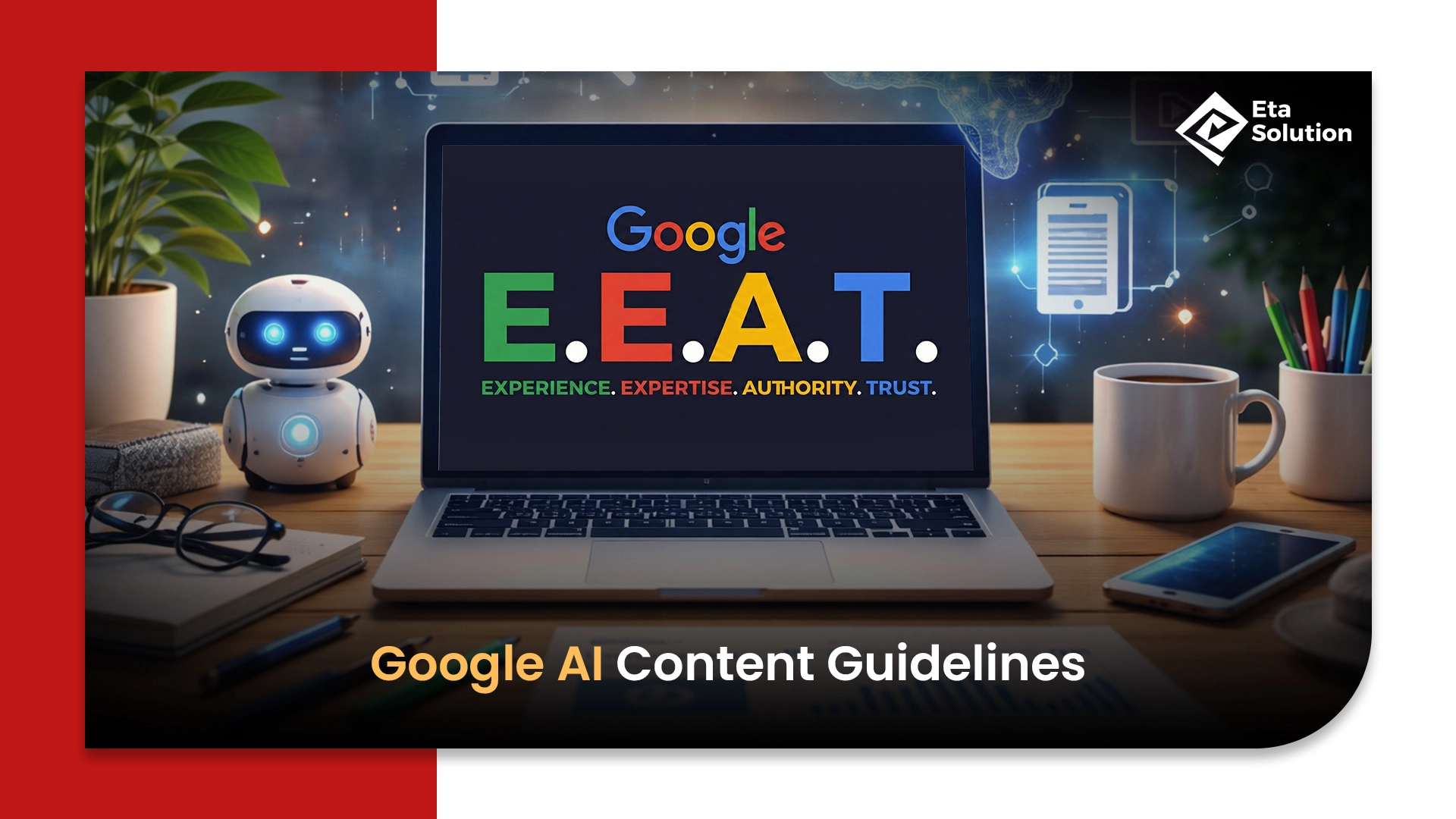
The E-E-A-T has become an essential element of the Google ranking structure encompassing the following four factors: Experience, Expertise, Authoritativeness, and Trustworthiness; as such are the building blocks for receiving high rankings on the Google search results.
AI provides structure, summarisation, and acceleration assistance with research; however, E-E-A-T will be human-driven or created.
That means:
- First-hand insights
- Real data
- Field experience
- Industry interpretation
Quality raters are now instructed to flag automated content with no insight as low quality.
So the equation becomes clear: AI produces drafts. Humans produce authority.
Google Spam Content Policy and Scaled AI Publishing
The biggest risk today is scaled content abuse. Google’s spam content policy warns against generating large volumes of AI pages without meaningful value.
Penalty triggers include:
- Repetitive keyword-stuffed articles
- Unverified information
- Automated content networks
- Paraphrased competitor content
The system evaluates originality, engagement, and credibility signals. This is why bulk AI blog farms collapsed in rankings across industries.
Statistical Trends Shaping AI Search and Rankings
AI is not just influencing content creation. It’s reshaping how search works.
Key trends:
- AI Overviews expanded from 7 to 229 countries in a year.
- There was a major increase in exposure to AI-generated answers for some searches in 2024 relative to 2025.
- The Increase in the dominance of synthetic content will likely decrease the number of sources providing answers from outside of the AI universe, as part due to less competition.
The net effect of these trends will be that there will be fewer people clicking on generic content and more people seeing content from credible sources that are experience-rich.
Google Search Quality Guidelines Demonstrate in Real Life
Most businesses are confused or ignorant about how the search quality guidelines apply to day-to-day marketing.
Using Google’s automated ranking systems means you will be creating content for the user first, as opposed to trying to get high rankings in Google.
In practical terms:
- Opinionated analysis beats generic explainers
- Case studies beat listicles
- Depth beats frequency
The brands winning today are not publishing more. They are publishing smarter.
What This Means for a Digital Marketing Agency in India
The definition of expertise has changed. To be seen as the best digital marketing agency in India, publishing blogs is not enough. Agencies must prove:
- Real campaign outcomes
- Industry insights
- Original research
- Technical depth
AI can accelerate production. But credibility still drives ranking. That is why agencies blending human expertise with AI workflows are outperforming both traditional writers and automation-heavy teams.
Real Industry Movement and Policy Pressure
An ever-shifting dynamic in ecosystems has shifted from search engine optimization (SEO) to an AI-assisted summary format. European Publishers recently made antitrust filings against manufacturers of AI summaries, claiming they have utilized their work without fair compensation.
UK regulators seek to ensure transparency in AI-generated search summaries, requiring Google to enhance attribution and source visibility. The competition to obtain or maintain visibility is increasing as a new way of establishing power is happening.
How Smart Brands Use Google AI Generated Content Guidelines
Winning strategies are already clear inside high-performing teams:
- AI for research and structure
- Human experts for insight
- Editorial layers for trust
- Data for differentiation
This hybrid model aligns with Google AI generated content guidelines and improves engagement signals.
AI is not replacing strategy. It is amplifying good strategy and exposing weak thinking.
The Strategic Role of a Digital Marketing Agency
Businesses now rely on partners who understand both algorithms and audiences. The Best Digital Marketing Agency In India will:
- Audit AI content credibility
- Align with Google search quality guidelines
- Build authority-driven content ecosystems
- Produce experience-led narratives
Ranking today depends less on optimization hacks and more on institutional knowledge.
The Future of Google Ranking Guidelines for AI Content
The trajectory is obvious. Search is moving toward:
- AI-assisted discovery
- Fewer low-quality pages
- Deeper credibility signals
- Authority-led ranking
Google is not fighting AI. It is filtering noise. The brands that survive this shift will be the ones that treat content as intellectual property, not production output.
The real question is not whether AI content can rank. It is whether your content deserves to.
Yes, Google allows AI-generated content as long as it is helpful, original, and created for users rather than just for search rankings. Google’s focus is on the quality of the content, not the method used to create it. Whether content is written by a human, AI, or a combination of both, it must follow Google’s E-E-A-T principles (Experience, Expertise, Authoritativeness, and Trustworthiness) and provide genuine value to readers.
Yes, AI-generated content can rank on Google if it meets Google’s quality standards. Content that is well-structured, accurate, relevant, and useful for users can perform well in search results. However, low-quality AI content, spammy articles, or content created only to manipulate rankings may be penalized. The key is to review, edit, and enhance AI-generated content before publishing.
Google has stated that AI is not against its guidelines, but using AI solely to create large volumes of low-quality content for ranking purposes violates its spam policies. Google prioritizes people-first content, meaning the content should solve user problems, answer questions clearly, and provide reliable information.
To make AI-generated content SEO-friendly, you should:
Add human editing and fact-checking
Include original insights or expertise
Optimize headings, keywords, and structure
Ensure the content answers search intent
Add credible sources and examples
Combining AI with human expertise and SEO optimization helps create content that performs well in search engines.
Google does not require mandatory disclosure for AI-generated content. However, transparency can help build user trust and credibility. Some websites mention that AI tools were used in content creation but reviewed by experts. The most important factor is that the content remains accurate, trustworthy, and useful.

What started as a passion for marketing years ago turned into a purposeful journey of helping businesses communicate in a way that truly connects. I’m Heta Dave, the Founder & CEO of Eta Marketing Solution! With a sharp focus on strategy and human-first marketing, I closely work with brands to help them stand out of the crowd and create something that lasts, not just in visibility, but in impact!


How to Audit a Google Ads Account Like an Expert

Omnichannel Marketing Strategies for eCommerce Brands