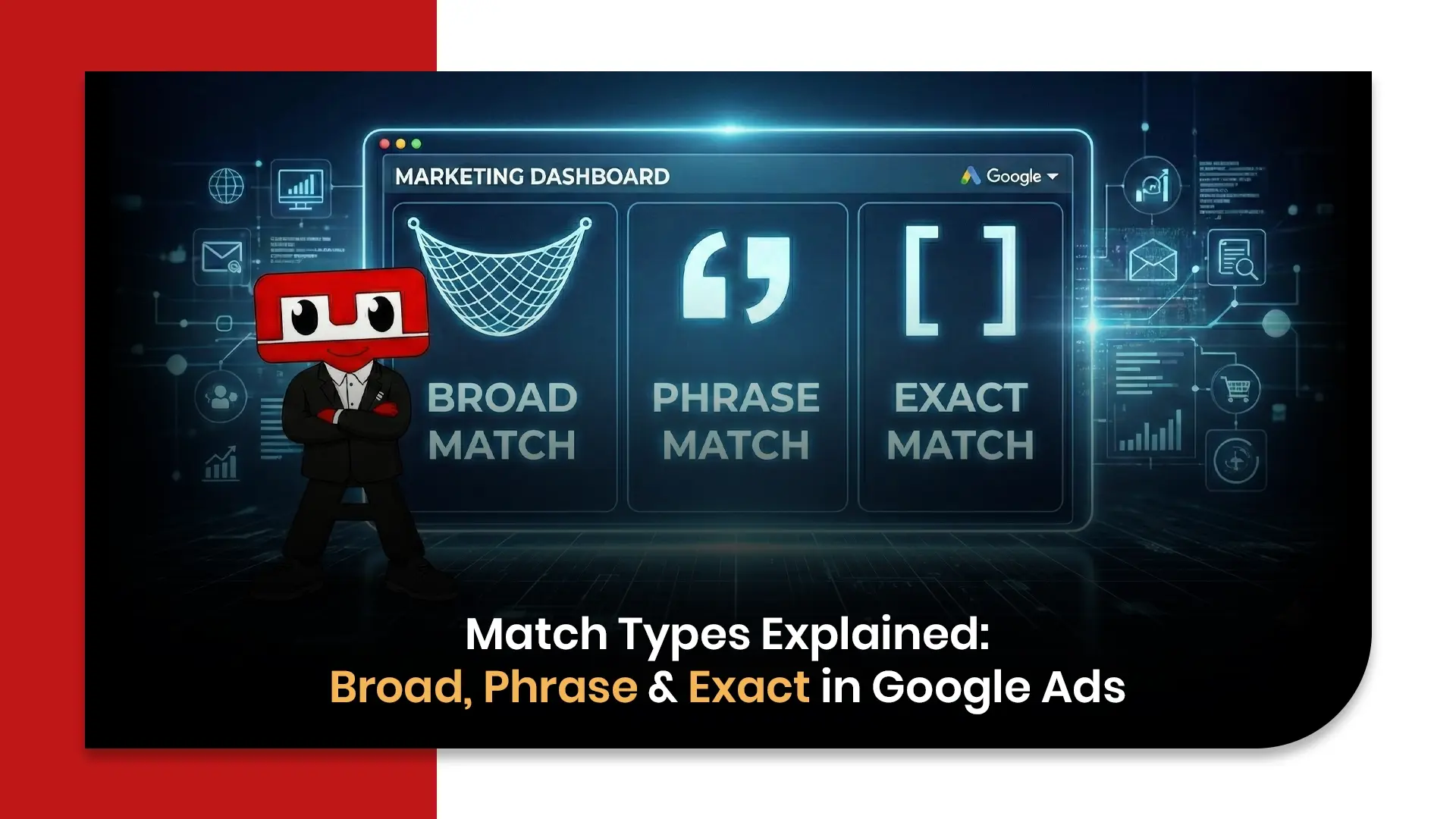
Google Ads Match Types Explained: Broad, Phrase & Exact Keywords
Most advertisers don’t lose money on Google Ads because of bad ads. They lose it because they let the wrong searches trigger those ads. That problem starts and ends with match types.
If you have ever looked at a search term report and wondered why your ad showed for something wildly unrelated, this article is for you. We are going to break down Google Ads match types the way experienced PPC managers actually use them today, not the oversimplified definitions you’ve seen a hundred times.
This is not beginner theory. This is what works in real accounts.
Introduction to Google Ads Match Types
Match types decide how closely a user’s search must align with your keyword before your ad is even eligible to appear. They sit quietly in the background, controlling reach, relevance, cost, and data quality.
Here’s a stat most blogs skip. According to internal agency audits shared at recent PPC conferences, over 60 percent of wasted spend in mature accounts comes from poor keyword matching, not bidding or creatives. That makes keyword match types explained properly one of the highest-ROI skills in paid search.
Used well, match types fuel scale. Used poorly, they bleed budgets.
What Is Broad Match in Google Ads
Broad match allows your ads to show for searches that Google considers “related” to your keyword. This includes synonyms, variations, implied intent, and contextual meaning.
For example, a broad match keyword like business accounting software can trigger ads for searches like bookkeeping tools or finance software for small companies. This is why broad match keywords feel powerful and dangerous at the same time.
What most people miss is that broad match today is not the same as it was five years ago. Since Google’s shift toward intent-based matching, broad match heavily relies on conversion data, audience signals, and account history.
Advantages and Disadvantages of Broad Match
Broad match shines when volume and learning matter more than precision.
Advantages include:
- Maximum reach across related queries
- Faster data collection for new campaigns
- Better performance when paired with smart bidding
But the disadvantages are real:
- Higher risk of irrelevant traffic without strong negatives
- Less control over exact query intent
- Can inflate costs in competitive auctions
Industry insiders now use broad match almost exclusively with automated bidding and strict search term monitoring. Without that, it’s like giving Google your credit card and hoping for the best.
What Is Phrase Match in Google Ads
Phrase match sits between control and flexibility. Your ad appears when the user’s query includes the meaning of your keyword, even if extra words appear before or after.
With phrase match keywords, intent matters more than word order. A keyword like enterprise CRM software can match the best enterprise CRM software for sales teams, but won’t drift as wildly as a broad match.
Phrase match is where many profitable accounts live because it balances relevance with scale.
Advantages and Disadvantages of Phrase Match
Phrase match gives advertisers room to grow without losing grip.
Its advantages:
- Strong intent alignment
- Better search term quality
- Easier optimization than broad match
Its limitations:
- Less reach compared to broad match
- Can miss emerging long-tail queries
- Still needs active negative keyword management
Most seasoned PPC teams treat phrase match as the backbone of Google Ads keyword targeting, especially in lead generation and B2B campaigns.
What Is Exact Match in Google Ads
Exact match is often misunderstood. It no longer means “exact wording only.” It means exact intent.
Exact match keywords allow ads to show for searches that closely match the meaning of your keyword, including minor variations. The benefit is precision. The trade-off is volume.
Exact match works best when you already know which queries convert and want to protect efficiency.
Advantages and Disadvantages of Exact Match
Exact match is built for control.
Advantages:
- Highest relevance and predictability
- Strong Quality Scores
- Easier budget management
Disadvantages:
- Limited scale
- Slower data accumulation
- Can miss new intent patterns
In high-CPC industries, exact match is often the foundation of a disciplined PPC keyword strategy.
How to Choose the Right Match Type for Your Campaign
Choosing a match type is not about preference. It’s about objectives.
- If you are launching a new campaign with limited data, broad match helps discover demand.
- If you are optimizing for cost-per-lead, phrase match brings balance.
- If you are scaling profitably, exact match protects margins.
Agencies offering Google Ads Services in Ahmedabad often structure accounts with all three match types, each serving a different purpose across the funnel.
Tips for Combining Match Types for Better ROI
High-performing accounts rarely rely on a single match type.
A practical structure looks like this:
- Broad match for discovery and volume
- Phrase match for intent refinement
- Exact match for efficiency and scale
Support this with consistent search term analysis, negative keyword expansion, and aligned bidding rules. This layered approach improves Google Ads optimization without sacrificing control.
Common Mistakes to Avoid When Using Match Types
The most common mistake is trusting match types without verification.
Other costly errors include:
- Running broad match without negatives
- Using exact match too early
- Mixing match types in the same ad group
- Ignoring search term reports
At recent paid media roundtables, senior strategists emphasized that match types influence paid search keywords quality more than ad copy does. That should tell you where attention belongs.
The Bigger Picture: Match Types and Bidding
Match types do not work in isolation. They interact deeply with your Google Ads bidding strategy.
- Broad match performs best with smart bidding.
- Exact match often thrives with tighter manual or capped strategies.
- Phrase match adapts well to hybrid setups.
This is why advanced teams evaluate match types and bidding together, not separately.
Final Thoughts
Match types are not settings you “set and forget.” They are levers. Strategic ones.
If your account is not delivering predictable growth, the issue is rarely creativity. It is usually structure, intent alignment, and how well your match types reflect real user behavior.
Brands investing seriously in Google Ads Services in Ahmedabad increasingly audit match types before touching budgets or creatives. That alone should change how you think about them.
The real question is not which match type is best. It’s whether your current setup is helping Google find the right users or just expensive ones.
Absolutely. Even with AI and automation, match types remain crucial for controlling traffic quality, managing budgets, and aligning ads with user intent. Smart advertisers combine match types with data-driven optimization for best results.
Indirectly, yes. Relevant keyword matching improves CTR, ad relevance, and landing page experience, all of which contribute to a higher Quality Score. Poor match selection can lead to irrelevant clicks and lower performance.
Yes, and it’s often recommended. Many advertisers use:
Broad match for discovery
Phrase match for controlled scaling
Exact match for conversions
This layered approach helps maximize performance while maintaining control.
Negative keywords prevent ads from showing for unwanted searches. They can also be set as Broad, Phrase, or Exact. Using negative keywords is essential—especially with Broad match—to filter out irrelevant traffic and protect your ad budget.
No. Google Ads no longer requires quotation marks for Phrase match. You simply select “Phrase match” when adding keywords in your campaign. The matching behavior is now intent-based, not just word-based.

What started as a passion for marketing years ago turned into a purposeful journey of helping businesses communicate in a way that truly connects. I’m Heta Dave, the Founder & CEO of Eta Marketing Solution! With a sharp focus on strategy and human-first marketing, I closely work with brands to help them stand out of the crowd and create something that lasts, not just in visibility, but in impact!

Google Ai Content Guidelines
How User Intent Drives Modern Search Strategies