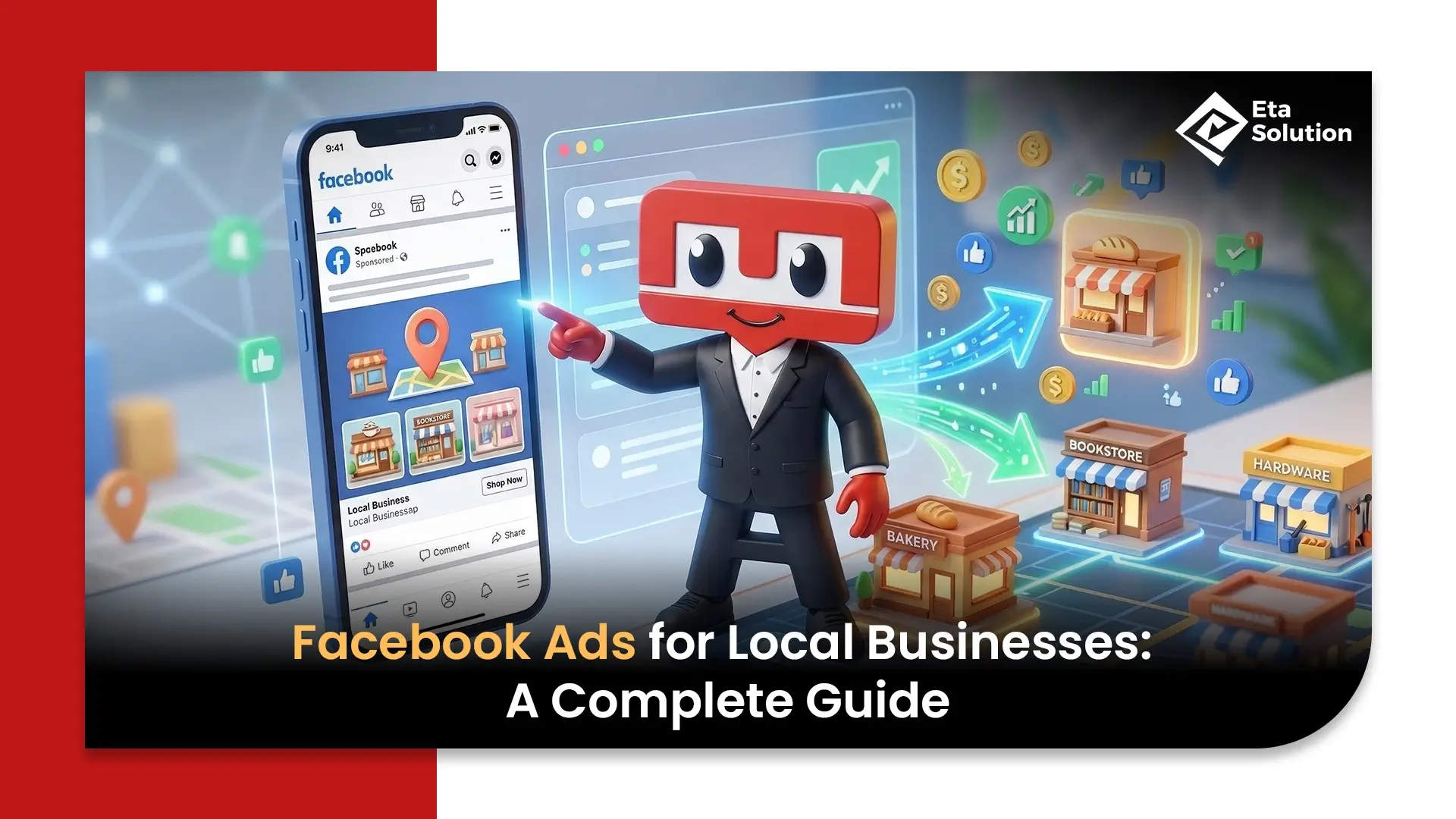
How to Run Facebook Ads for Local Businesses (Complete Guide)
One week, customers walk in like the universe is on your payroll. The next week, it’s silent enough to hear your own bad decisions echo. And somehow, this is considered normal.
It’s not.
What you’re really running isn’t a business with predictable demand. It’s a business that depends on timing, visibility, and whether people happen to remember you at the right moment.
That’s exactly where Facebook ads for local business stop being optional and start acting like control.
The system determines your presence status through its decision-making process.
Why Local Businesses Need Facebook Ads for Their Success
People now discover local areas through different methods because they no longer use traditional searching methods. People now create their own selection process through scrolling and filtering options.
According to Meta’s internal data, over 1 billion users engage with local business content weekly. More than 70% of users find new local businesses through Facebook and Instagram, according to the research.
That changes how visibility works. Instead of waiting for intent, you can create it.
A solid local Facebook advertising strategy allows you to:
- Show up before search intent exists
- Stay visible during decision-making
- Build familiarity before competitors even enter the picture
Most small businesses still rely on organic posts and occasional boosts. That’s not a strategy. That’s guesswork.
Setting Up Facebook Business Manager and Ad Account
This is where most campaigns quietly fail before they even start. Your Facebook campaign setup guide should begin with structure, not ads.
You need:
- Business Manager properly set up
- Ad account ownership (not shared access chaos)
- Verified domain
- Pixel connected to your website
What experienced marketers know but rarely say: poor setup ruins data quality. And poor data means bad decisions.
A clean setup gives you:
- Accurate attribution
- Better optimization signals
- More stable scaling
Your advertising campaigns will fail if your backend system remains disorganized, regardless of your creative skills.
Local Target Audience Definition (Geo-Targeting & Demographics)
The process of implementing geo targeting Facebook ads requires only two steps, which include dropping a pin and setting a radius. The system provides a basic interface for users to create their first location-based advertising campaign.
The system offers three distinct levels of advanced geographic boundary advertising, which include three different methods of advanced local targeting.
- Radius targeting (1-10 miles depending on business type)
- Behavior filters (recent movers, frequent shoppers, device users)
- Custom audiences (past visitors, customer lists)
- Lookalike audiences based on local buyers
For example, a salon doesn’t just use Facebook ads targeting nearby customers. It targets:
- Women aged 22-45
- Within 5 miles
- Interested in beauty services
- Engaged with similar brands
The most effective Facebook ads that reach local customers need advertisers to combine customer proximity with their intent signals. The point at which most campaigns achieve success occurs through this particular process.
The Right Facebook Ad Objectives for Local Goals
The wrong objective becomes your selection when you select an incorrect objective. The system appears to function correctly, but it fails to operate properly.
The process of aligning objectives with outcomes requires the following steps:
- Brand awareness → for local brand awareness ads
- Traffic → for website visits
- Lead generation → for Facebook lead generation ads
- Conversions → for bookings, purchases
Meta’s algorithm optimizes based on your objective. If you pick traffic, it will bring clicks. Not customers.
Local service ads Facebook campaigns often perform best with:
- Lead generation for service-based businesses
- Conversions for product-based businesses
A simple rule is to optimize for the result you actually care about.
Creating High-Converting Ad Creatives (Copy, Images & Video)
Creative is no longer decoration. It’s performance. Meta reported that creative accounts for over 50% of campaign success. Yet most ads still look like digital flyers.
Here’s what works in small business social media ads:
Visuals
- Real locations, not stock images
- Faces over products
- Movement over static
Copy
- First line = scroll stopper
- Focus on problem → solution → outcome
- Keep it conversational
Formats
- Short-form video (Reels-style) is dominating
- Before/after content performs well for services
- Testimonials outperform claims
Example pattern that works for Facebook ads for service providers:
- “Tired of [problem]?”
- Show proof
- Clear call to action
The goal isn’t to look “professional.” The goal is to look real and relevant.
Budgeting and Bidding Strategies for Small Businesses
Most businesses don’t have a budget problem. They have a patience problem.
A proper Facebook ads Budget strategy isn’t about spending more. It’s about spending long enough to learn.
Key principles:
- Start with $10-$30/day per ad set
- Run for at least 5-7 days before judging
- Avoid constant edits (resets learning phase)
What experienced advertisers do:
- Kill underperforming ads early
- Scale winners gradually (20-30% increments)
- Reinvest profits into high-performing campaigns
Meta ads for small business campaigns don’t need huge budgets. They need consistency and discipline.
Using Facebook Lead Ads for Local Lead Generation
Facebook lead generation ads remove friction. No website. No loading time. No drop-offs. That’s why they convert.
Average conversion rates for lead ads can go 2-3x higher than landing pages for local services.
Best practices:
- Keep forms short (name, phone, one qualifier)
- Add a strong offer (discount, consultation, audit)
- Use instant follow-up (calls or WhatsApp)
Speed of response matters more than lead quality. Businesses that respond within 5 minutes convert significantly more leads. Lead ads don’t fail because of bad leads. They fail because of slow follow-ups.
Retargeting Local Customers with Custom Audiences
Most people don’t convert on the first interaction. Retargeting fixes that.
Custom audiences allow you to re-engage:
- Website visitors
- Video viewers
- Page engagers
- Existing customers
This is where local service ads Facebook campaigns become profitable.
Effective retargeting includes:
- Testimonials
- Offers
- Reminders
- Urgency-based messaging
A smart local Facebook advertising strategy always includes retargeting. Otherwise, you’re paying to introduce yourself over and over again.
Tracking Conversions with Facebook Pixel
If you’re not tracking, you’re guessing.
Facebook Pixel tracks:
- Page views
- Add to cart
- Purchases
- Leads
But here’s the part most businesses miss: Event quality matters.
You should:
- Set up standard events properly
- Use conversion API if possible
- Verify domain and prioritize events
Without this, your campaigns won’t optimize correctly. And then people blame the platform.
Measuring, Optimizing, and Scaling Local Facebook Ad Campaigns
Data is useless if you don’t know what to look for.
Key metrics that actually matter:
- Cost per lead
- Conversion rate
- Frequency
- Return on ad spend
Ignore vanity metrics like likes and comments.
Optimization should focus on:
- Creative testing
- Audience refinement
- Offer improvement
Scaling happens when:
- You have consistent results
- Your cost per result is stable
- Your funnel is working
This is where Facebook ad management services become valuable. Not for running ads, but for making decisions based on data.
Closing Take
At some point, you have to decide whether you’re running ads… or just pressing buttons and hoping something works.
Because that’s what most local businesses are doing. Launch a campaign, tweak a few settings, watch numbers go up and down, then call it “testing.”
It’s not testing. It’s guessing with a budget.
Meanwhile, there are businesses in your area treating this like infrastructure. Campaigns don’t stop. Data doesn’t get ignored. Decisions aren’t based on mood.
They know exactly:
- What’s bringing leads
- What’s wasting money
- What needs to scale
This is where Facebook ad management services actually start to matter. Not because someone else runs your ads, but because someone is finally making decisions based on patterns instead of panic.
Because in the end, this isn’t about learning Facebook. It’s about whether your business shows up predictably… or disappears every time demand dips.
There’s no fixed amount, but most local businesses can start with ₹300–₹1000 per day. The key is to test small budgets first, see which ads perform best, and then increase spending on winning campaigns. For example, run 2–3 ad variations for a week, track results (clicks, leads), and scale the one that gives better ROI.
Lead generation ads, engagement ads, and video ads usually work best.
- Lead ads help collect customer details directly
- Video ads build trust and show your product/service in action
- Offer ads (discounts, limited deals) attract quick attention
For example, a restaurant can run a short food video with a “Flat 20% Off Today” offer to drive immediate visits.
Start by selecting a specific location (city or radius targeting). Then refine your audience using interests, age group, and behavior. For example, a gym can target people aged 20–40 interested in fitness, health, or weight loss within a 5 km area. You can also retarget people who visited your website or interacted with your page for better results.
It depends on your goal, but common high-performing CTAs include:
- “Call Now” (for immediate inquiries)
- “Book Now” (for services like salons or clinics)
- “Get Offer” (for discounts)
- “Send Message” (for quick chats on WhatsApp/Messenger)
For example, a clinic may get better results with “Book Appointment” instead of just “Learn More.”
Focus on three main things:
- Creative: Use high-quality images/videos with clear messaging
- Offer: Give a strong reason to act (discount, free trial, etc.)
- Targeting: Refine audience based on performance data
Also, regularly check metrics like CTR (click-through rate) and cost per lead, and make small improvements instead of big changes.

What started as a passion for marketing years ago turned into a purposeful journey of helping businesses communicate in a way that truly connects. I’m Heta Dave, the Founder & CEO of Eta Marketing Solution! With a sharp focus on strategy and human-first marketing, I closely work with brands to help them stand out of the crowd and create something that lasts, not just in visibility, but in impact!
Facebook Ads for Local Businesses: A Complete Guide
How to Fix Plugin Conflicts in WordPress