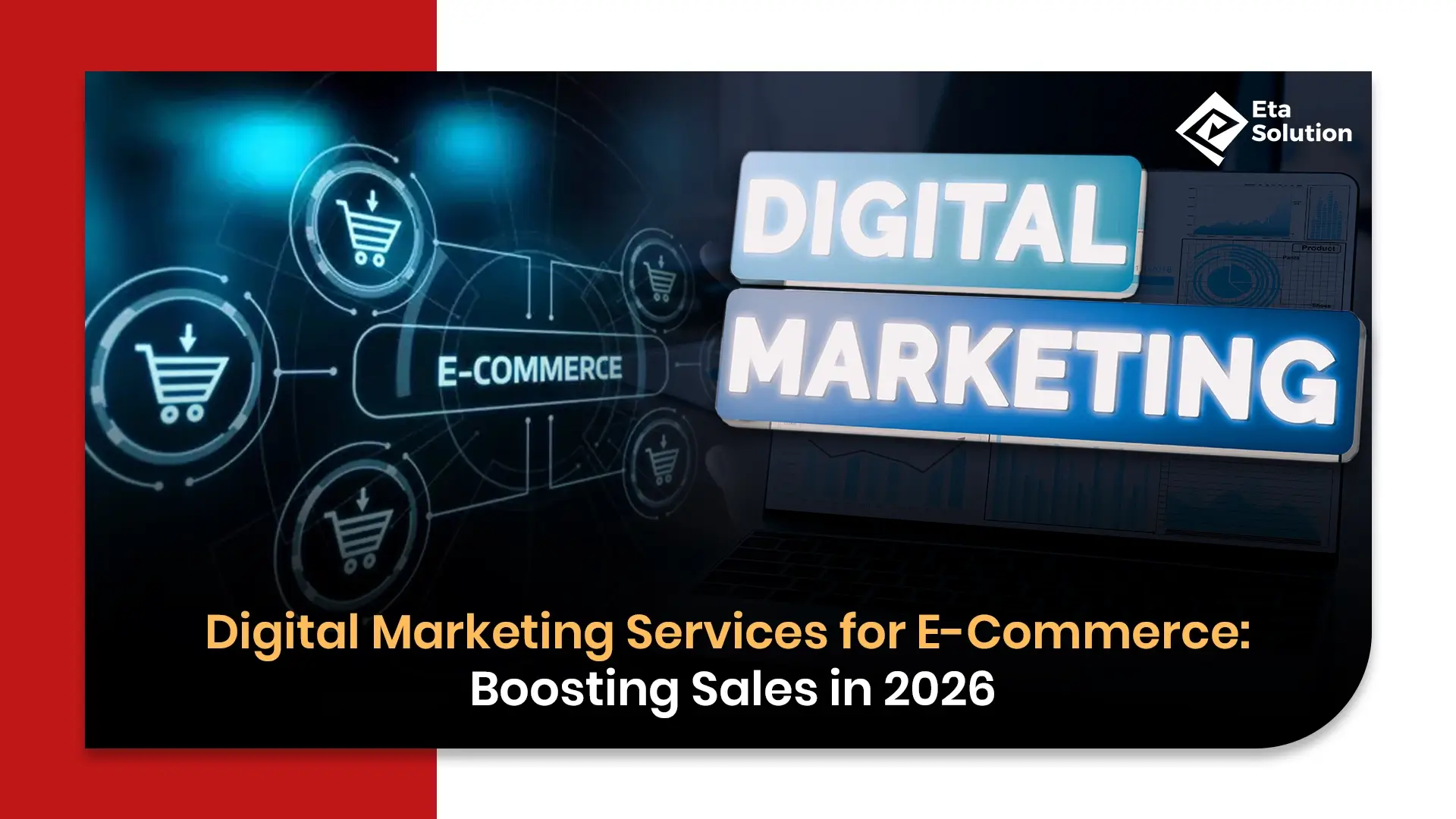
Digital Marketing Services for E-Commerce Growth in 2026
At the end of 2025, Shopify gave a sneak peek to their partners in a confidential meet in New York about an internal stat which was not very obvious: more than 70 percent of e-commerce brands with rapid growth were a mix of multichannel acquisition strategies. They didn’t depend on one channel only anymore. The reason for their success was that the marketing systems they had in place communicated with each other. SEO data guided the ads. Email flows were very reactive to on-site interactions. AI was continually tweaking offers.
That shift defines digital marketing for ecommerce in 2026. Growth is no longer about doing more marketing. It is about doing connected, intelligence-driven marketing that compounds results instead of leaking budgets.
This blog details how top e-commerce brands are planning their growth in 2026, what they strategies they are putting into action to get results, and where the knowledgeable marketers are moving their budgets without making any noise.
Live your eCommerce SEO to maximize organic traffic
Technology has evolved in the field of search, yet it is not dead. What changed is how Google evaluates commercial intent. In Ecommerce SEO 2026, category pages and product hubs outperform blogs when structured correctly.
Updated data from SEMrush shows that e-commerce sites with intent-mapped category pages see 43 percent higher conversion rates than those relying mainly on informational content.
What top teams are doing differently:
- Building category pages around buyer intent, not keywords alone.
- Using internal search data to identify high-intent queries customers type on the site.
- Optimizing for Google’s product-rich results and AI-generated summaries.
One lesser-known factor affecting rankings is crawl budget prioritization. Large e-commerce sites are now pruning low-performing filter URLs aggressively. This improves indexation of revenue-driving pages and boosts overall visibility.
SEO teams delivering the Best Digital Marketing Services in India for global brands are also aligning SEO with inventory data. If a product is out of stock for 30 days, its SEO priority is temporarily reduced. That prevents wasted crawl and ranking volatility.
Paid Advertising for Ecommerce That Still Delivers ROI
Paid advertising for ecommerce is no longer about platform hacks. In 2026, it is about signal quality. Meta and Google both confirmed at industry roundtables that first-party signals now outweigh interest-based targeting.
Winning brands focus on:
- Server-side tracking instead of browser-only pixels.
- Feed-based creative testing rather than static ad sets.
- Blending performance Max campaigns with manual control layers.
A real campaign insight worth noting: a US DTC apparel brand reduced CPA by 28 percent by syncing Google Ads bids with real-time inventory and margin data. Ads automatically pull back spend on low-margin SKUs during high-competition hours.
Paid media works best when it is not isolated. When handled by teams offering Best Digital Marketing Services in India, paid data often feeds directly into CRO and email flows, creating a closed feedback loop.
Content Marketing That Actually Drives Sales
Content marketing for online stores has matured. Long-form blogs alone rarely move revenue. What works now is commerce-first content.
High-performing formats in 2026 include:
- Comparison guides built around real product usage data.
- Expert-backed buying frameworks rather than generic reviews.
- Video-supported landing pages that reduce bounce rates by up to 34 percent.
Nike’s 2025 campaign, integrating athlete-led product education into its content ecosystem, increased assisted conversions by 19 percent. The key takeaway was not storytelling alone, but structured storytelling tied to decision stages.
Content teams focusing on boosting ecommerce sales now collaborate closely with UX and analytics teams. Content is measured by revenue influence, not pageviews.
Email Marketing for Ecommerce That Retains Customers
Email marketing for ecommerce remains the highest ROI channel, but batch campaigns are fading. Behavior-based automation is now the baseline.
Advanced teams are using:
- Predictive send-time optimization driven by AI.
- Micro-segmentation based on browsing depth, not just purchase history.
- Dynamic pricing blocks for loyalty tiers.
According to Klaviyo’s 2026 benchmark report, brands using predictive replenishment emails saw a 22 percent increase in repeat purchase rates.
The smartest brands treat email as a profit center, not a broadcast tool. Many now align email KPIs directly with contribution margin, not revenue alone.
Social Media Marketing Ecommerce Brands Depend On
Social media marketing ecommerce strategies have shifted toward social commerce infrastructure. Platforms are pushing in-app checkout, but trust remains the real differentiator.
What is working:
- Creator-led product demos with transparent pricing.
- Short-form content tied to limited-time offers.
- Retargeting social viewers via email and SMS, not ads alone.
TikTok Shop’s internal data shared at CommerceNext 2025 showed that products with creator explanation videos converted 2.3x higher than polished brand ads.
Social teams collaborating with SEO and paid teams generate stronger results than siloed execution. This integrated approach is increasingly expected from providers offering Best Digital Marketing Services in India.
Influencer and Affiliate Marketing in 2026
Influencer marketing ecommerce has moved away from vanity metrics. Performance-based collaborations dominate.
Brands now prioritize:
- Revenue-share influencer models.
- Long-term creator partnerships instead of one-off posts.
- Affiliate marketing for ecommerce programs integrated into CRM systems.
A lesser-known trend is influencer whitelisting. Brands run ads from creator handles, combining authenticity with paid scale. This hybrid approach has shown 30 to 40 percent lower CPMs in competitive niches.
Personalization and AI-Powered Ecommerce Marketing
AI-powered ecommerce marketing strategies are no longer experimental. It is operational.
Advanced personalization in ecommerce includes:
- AI-driven product bundles based on session behavior.
- Personalized landing pages for repeat visitors.
- Dynamic offers based on predicted lifetime value.
Amazon’s internal personalization framework, discussed at a closed AWS retail summit, revealed that even small personalization tweaks can lift AOV by 5 to 8 percent when applied consistently.
The real edge comes from restraint. The best teams personalize selectively, avoiding over-automation that feels intrusive.
Analytics and Conversion Rate Optimization Ecommerce Teams Rely On
Conversion rate optimization ecommerce strategies now rely on fewer tools, but deeper insights. Heatmaps alone are not enough.
High-performing teams use:
- Server-side analytics for accurate attribution.
- Cohort-based analysis instead of session-based metrics.
- Experimentation frameworks tied to revenue impact.
Ecommerce analytics tools like GA4, combined with product analytics platforms, allow brands to identify friction points across devices. One electronics brand increased checkout completion by 14 percent by removing a single unnecessary verification step discovered through cohort analysis.
Multi-Channel Ecommerce Marketing That Scales
Multi-channel ecommerce marketing is not about being everywhere. It is about orchestration.
Effective integration includes:
- Shared KPIs across SEO, paid, email, and social.
- Unified customer profiles.
- Budget reallocation based on channel-assisted revenue.
Companies going large-scale worldwide usually depend on partners providing the Best Digital Marketing Services in India to leverage their multi-region attribution, cost efficiency, and 24/7 optimization cycles expertise.
Final Thoughts
The year 2026 will be the time of the rise of those brands that will be able to integrate marketing seamlessly into their system, rather than treating it as a mere checklist. The tools will become less significant as the teams get more aligned. The channels will matter less as more data will flow. The tactics will matter less when there is the right timing.
The awkward question that every e-commerce leader ought to pose to themselves is this: Are your marketing channels collaborating, or are they just competing for credit?
The answer usually explains why growth feels harder than it should.
In 2026, digital marketing boosts e-commerce sales by combining AI analytics, automation, and personalization. Advanced targeting ensures ads reach high-intent buyers, while SEO brings long-term organic traffic. Email and SMS automation re-engage abandoned carts, and CRO improves checkout experiences. Together, these services reduce acquisition costs, improve conversions, and increase customer lifetime value.
The most effective services for e-commerce in 2026 include:
SEO for consistent organic traffic
Google Shopping & Performance Max ads for high-intent buyers
Social media ads on Instagram, TikTok, and Facebook
Email & SMS marketing for retention and repeat sales
Conversion rate optimization (CRO) to reduce cart abandonment
Marketing automation & AI personalization for scalable growth
A combination of these services delivers the best results.
SEO remains crucial in 2026 because organic traffic delivers higher trust, lower acquisition costs, and long-term visibility. With Google’s AI-powered search and voice results, optimized product pages, structured data, fast loading speed, and helpful content help e-commerce brands rank higher. SEO also improves discoverability in image search, local search, and AI summaries.
Paid ads allow e-commerce businesses to target users actively searching for products. In 2026, platforms use AI-based bidding, predictive audiences, and creative optimization to improve ROI. Google Shopping ads, social media video ads, and retargeting campaigns help capture buyer intent, bring users back to abandoned carts, and increase conversion rates quickly.
CRO focuses on improving the percentage of visitors who complete desired actions such as purchases or sign-ups. For e-commerce, CRO includes optimizing product pages, checkout flows, mobile usability, page speed, trust signals, and payment options. In 2026, CRO uses heatmaps, A/B testing, and AI insights to maximize sales from existing traffic.

What started as a passion for marketing years ago turned into a purposeful journey of helping businesses communicate in a way that truly connects. I’m Heta Dave, the Founder & CEO of Eta Marketing Solution! With a sharp focus on strategy and human-first marketing, I closely work with brands to help them stand out of the crowd and create something that lasts, not just in visibility, but in impact!
Top Digital Marketing Trends to Watch in 2026