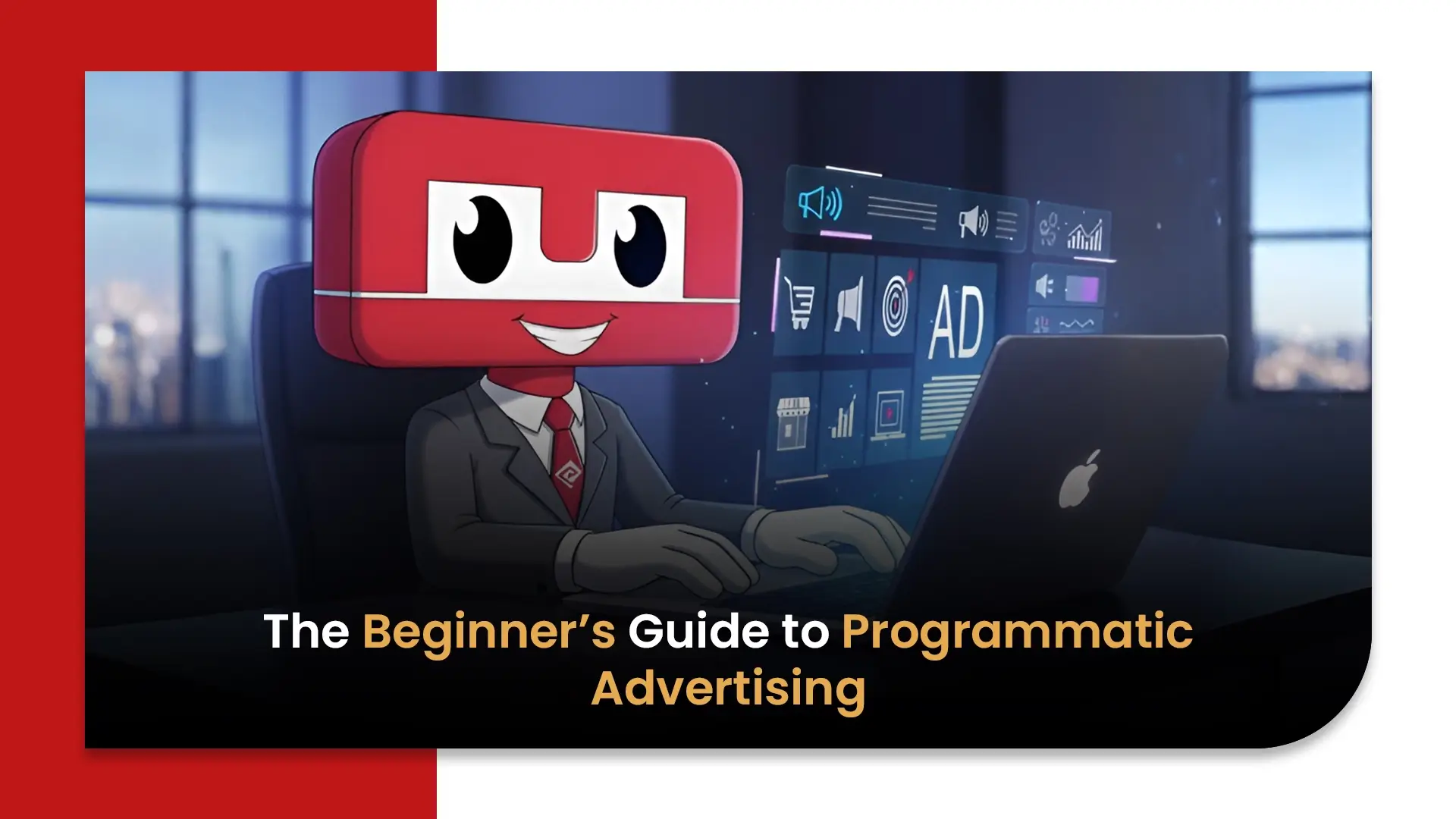
Programmatic Advertising Explained for Beginners
Previously, advertisers would sometimes wait weeks for their campaign decision, and now decisions can happen in milliseconds. Additionally, where media buying typically took several rounds of calls, negotiations, and spreadsheets, it now occurs through algorithms before a page even loads.
Programmatic advertising has evolved from a trend that was only recently recognized. Nowadays, 90%+ of all digital display ads are purchased programmatically, making automation the preferred method for brands to access consumers. Market growth remains intact, with estimates indicating that over the next 10 years, global programmatic investment will exceed trillions.
This document intends to provide education on how programmatic advertising actually works, what will change in 2026, and help marketers know how to effectively spend their budgets going forward.
Programmatic Advertising Defined And Why It Dominates Digital Media Purchasing
Programmatic advertising is an automated method of purchasing digital ads that uses data, algorithms, and real-time systems to purchase and deliver advertisements.
Rather than individuals engaging in placing ad buys via negotiations, advertisers use automated systems to determine where and when to place advertising. Thus, there is less opportunity for human error that would otherwise occur using traditional methods of advertising.
- Who sees the ad
- Where it appears
- How much to pay
- And when it runs
This is the base for digitally purchasing media today. It allows advertisers, publishers, data platforms, and algorithms all to be part of one live ecosystem that drives scalability of ad campaigns with near instant delivery. The execution of a programmatic ad campaign offers accurate targeting, automated ad campaign optimization, and rapid budget deployment. This is why programmatic has become the core of display ad automation and performance-driven ads.
Programmatic Technology – Technical Elements
Each ad impression involves many layers of technology. At the core are the following components:
Demand Side Platforms (DSP Advertising):
Advertisers create budgets, targeted audiences, and performance goals for an ad campaign by using demand-side platforms. These platforms will automatically bid on available ad impressions.
Supply Side Platforms (SSP Platforms):
Publishers create supply-side platforms to allow available ad impressions for advertisers so they can maximize their revenue potential.
Ad Exchange:
This is the marketplace where buyers and sellers of ad impressions transact with each other in real-time.
Real-time Bidding (RTB):
When a user opens a page, the ad impression auction occurs in real-time. Algorithms are used to assess the available ad inventory data, and the advertisers will each make a real-time bid for that impression. The winning bid will be from the relevant advertiser that bid the highest price.
This process happens in milliseconds and allows programmatic media buying to scale across websites, apps, connected TV, and more.
The RTB market alone continues expanding rapidly, reflecting the increasing reliance on automated ad trading.
Programmatic Marketing Basics Marketers Often Overlook
Many assume programmatic is just automation. It’s actually decision intelligence.
The system uses:
- behavioral data
- contextual signals
- historical performance
- predictive modeling
To determine which ad gets served. That means campaign outcomes depend less on media placements and more on:
- data quality
- bidding strategy
- audience signals
- supply chain transparency
Experts now consider understanding the programmatic supply chain essential because inefficiencies, invalid traffic, and opaque inventory can drain performance budgets.
Market Reality: Numbers that Explain the Scale
Programmatic is not experimental anymore. It is dominant.
Cognitive Aides in the Industry:
- Today, over 90% Digital Display Ads are bought through Programmatic means.
- Programmatic advertising placement expenditures are continuing to increase every year, due to the automation of placing ads being the norm.
- For the year 2015, global advertising investment will approach $1 trillion, and the majority of this advertising investment growth will come from Digital Channels.
- Real time Bidding and Automated Advertising Buying Platforms are experiencing double-digit growth rates.
This scale explains why every major brand now integrates programmatic ad platforms into performance strategy.
Why Businesses Rely on Performance Marketing
Automation doesn’t remove complexity. It increases it.
Running programmatic campaigns requires:
- supply path optimization
- data partnerships
- bid strategy modeling
- creative testing at scale
- privacy compliance
That’s why brands partner with specialists. A Performance Marketing Company in Ahmedabad can manage cross-channel programmatic campaigns, integrate analytics pipelines, and align digital media buying with business KPIs rather than vanity metrics.
This isn’t just execution. It’s operational infrastructure for growth.
Privacy shifts reshaping programmatic marketing
The biggest transformation isn’t technology. It’s regulation and data access.
The phase-out of third-party cookies is forcing marketers to rely on:
- first-party data
- contextual targeting
- consent-driven tracking
The change to cookieless environments and consent structures is changing targeting techniques that are used throughout the programmatic ecosystem.
In addition, with experts indicating that privacy regulations will affect digital advertising in 2026 and be prepared for by some, it is suggested that brands that only utilize external data will struggle, while other brands that utilize strong first-party ecosystems will dominate.
New Trends that Industry Insiders are Watching
Programmatic is changing quickly, and here are the changes that experienced marketers are watching:
- Retail media networks: Retail data is being used as premium currency for targeting. Retail-driven programmatic spending is increasing dramatically.
- Curation vs Open auction: Curated inventory is growing, as Brands look to place importance on quality, identity, and safety of their brand.
- AI optimization: Algorithms are now optimally selecting for creative, bidding, and targeting simultaneously.
- Connected TV growth: Video and streaming are now major sources of programmatic dollars.
The commercial media convergence has created a shared ecosystem where advertising data has merged with transactional data.
This is the key difference between executing simple one-off campaigns versus developing more strategic forms of programmatic marketing using this new data set for maximum impact.
What Winning Brands are Doing Differently
Brands that succeed with programmatic don’t treat it as a media tactic. They treat it as a performance engine.
Winning approaches include:
- Integrating CRM and first-party data into programmatic ad platforms
- Aligning creative testing with audience signals
- Using predictive bidding instead of static budgets
- Prioritizing supply transparency
This is where display advertising automation becomes measurable business growth rather than ad spend.
Role of a Performance Marketing Company in Scaling Programmatic Media Buying
As complexity grows, businesses look for partners who understand both marketing and technology.
A Performance Marketing Company in Ahmedabad can:
- Connect DSP advertising tools with analytics systems
- Manage SSP platforms and publisher relationships
- Optimize real-time bidding performance
- Drive measurable ROI across programmatic channels
It shifts the conversation from impressions and clicks to acquisition, retention, and revenue.
The Future of Programmatic Advertising
The next phase won’t be about automation. It will be about intelligence.
Expect:
- Stronger AI-driven decision systems
- Privacy-first targeting models
- Deeper integration between ad tech and martech
- Fewer intermediaries in the ad exchange ecosystem
- Tighter accountability for media quality
Programmatic advertising is moving toward curated, data-driven environments where every impression must justify its cost.
And the brands that understand programmatic marketing basics today will control performance tomorrow.
Final Take
Programmatic advertising didn’t just change how ads are bought. It changed how marketing decisions are made. Algorithms now determine reach. Data defines relevance. Speed controls opportunity. But here’s the uncomfortable truth.
Most businesses are still using programmatic ads as a buying tool. The leaders are using it as a competitive advantage. As privacy tightens, AI evolves, and media fragmentation increases, the gap between “running campaigns” and “running performance ecosystems” will widen.
The question is no longer whether programmatic works. It’s whether your strategy is advanced enough to keep up with what it’s becoming.
Traditional digital advertising often involves manual buying, negotiations, and fixed placements. Programmatic advertising automates the entire process using data and machine learning. It enables real-time targeting, dynamic bidding, and more precise audience segmentation, making campaigns faster to launch and easier to optimize.
Key benefits include:
Better audience targeting
Real-time optimization
Automated buying process
Improved ROI and cost efficiency
Access to large ad inventory
Detailed performance tracking
Faster campaign execution
It allows advertisers to scale campaigns while maintaining precision.
Not necessarily. Programmatic advertising can work for both small and large budgets. Many platforms allow flexible daily spending limits and bidding controls. Beginners can start with small test campaigns, measure performance, and scale gradually. Costs depend on audience targeting, competition, and ad format.
Common programmatic platforms include:
Google Display & Video 360
The Trade Desk
MediaMath
Amazon DSP
Adobe Advertising Cloud
These platforms help advertisers manage bidding, targeting, and reporting from a single dashboard.
Programmatic advertising supports multiple formats, such as:
Display banner ads
Video ads
Native ads
Mobile ads
Connected TV (CTV) ads
Audio ads
Digital out-of-home (DOOH) ads
This flexibility allows brands to reach users across devices and channels.

What started as a passion for marketing years ago turned into a purposeful journey of helping businesses communicate in a way that truly connects. I’m Heta Dave, the Founder & CEO of Eta Marketing Solution! With a sharp focus on strategy and human-first marketing, I closely work with brands to help them stand out of the crowd and create something that lasts, not just in visibility, but in impact!