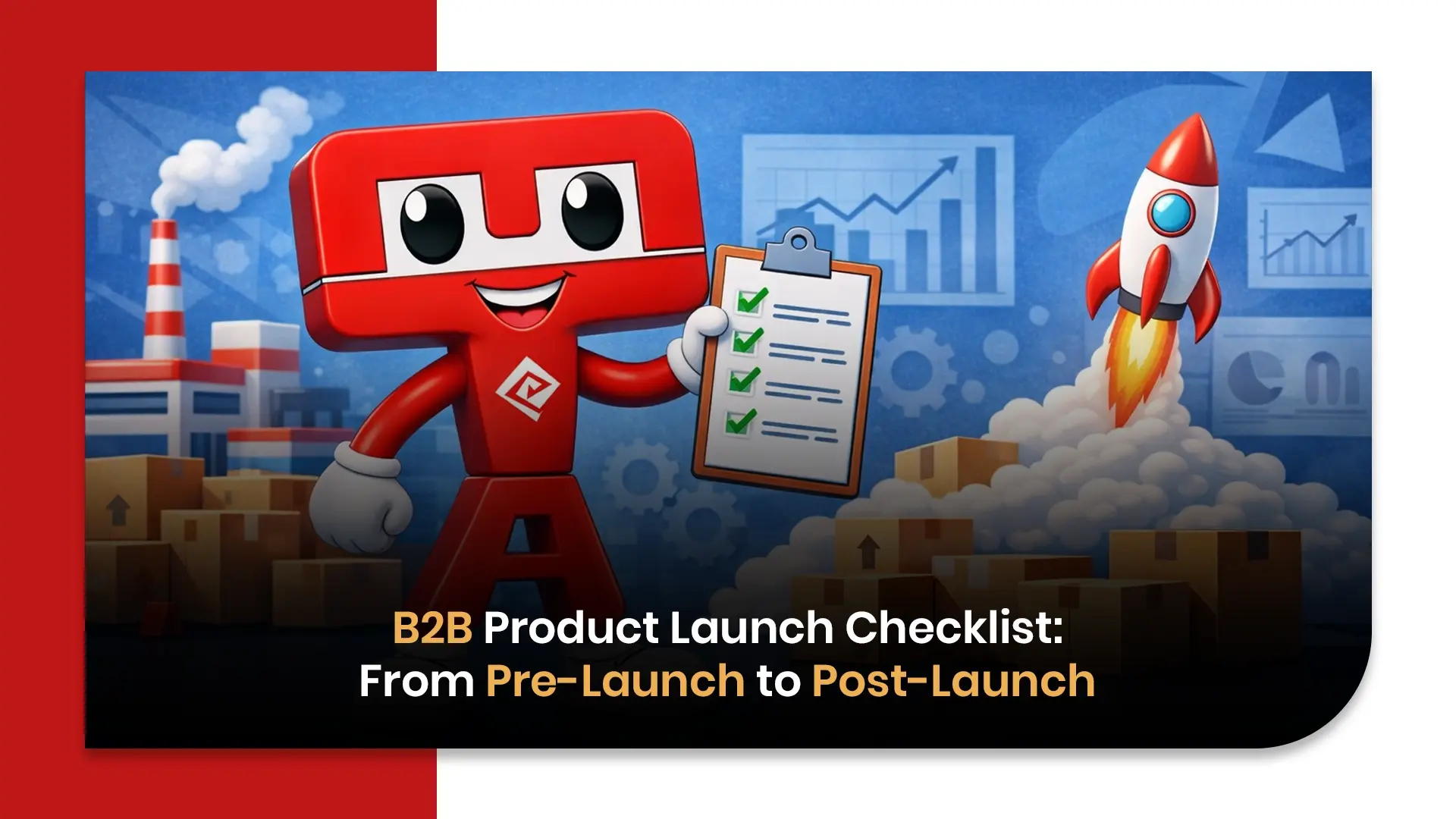
The Complete B2B Product Launch Checklist: Pre-Launch to Post-Launch
Most B2B product launches don’t fail loudly. They fade.
No crash. No backlash. Just low adoption, confused sales calls, and a pipeline that never quite wakes up. According to recent industry data, nearly 70% of B2B product launches miss their revenue or adoption targets within the first six months, not because the product is bad, but because the launch plan is weak or incomplete.
This is not another “announce, promote, celebrate” guide. This is a B2B product launch checklist built for teams who already know product launch marketing basics and want to get execution right, from early research to post-launch correction.
Introduction to B2B Product Launches
A B2B product launch is not an event. It’s a controlled rollout of clarity.
In B2B, you’re selling to buying committees, not individuals. Decisions take weeks or months. Messaging gets interpreted by sales, procurement, legal, and end users, often in different ways. That’s why strong B2B launches focus less on hype and more on alignment.
Companies with excellent performance think of launches as a system that connects market needs, position in the market, conference, and the development of long-term purchases. This mindset effectively distinguishes between launches that are generating customer demand from launches that are just sitting there with no customer feedback.
Market Research Prior to Launch
Market research in B2B is not about asking people what features they want. Buyers are famously bad at predicting what they’ll pay for.
What works better is identifying:
- What problem already has budget approval
- Where existing tools are failing
- Which internal metrics buyers are under pressure to improve
Recent Gartner research shows that B2B buyers spend only 17% of their buying journey meeting potential suppliers. The rest is internal discussion and independent research. That means your launch must speak to problems buyers already recognize, not educate them from scratch.
Talk to:
- Lost prospects from competitor tools
- Sales engineers who hear objections daily
- Customer success teams who see churn reasons early
This is the foundation of any serious product launch strategy B2B teams rely on.
Defining Target Audience and Buyer Personas
If your personal document says “CTO, mid-market, tech-savvy,” it’s useless.
In modern B2B launch planning, teams map decision roles, not just job titles. A single deal might include:
- A technical evaluator
- A budget owner
- A risk blocker
- An internal champion
Each role needs different launch messaging. The evaluator wants proof. The budget owner wants ROI. The blocker wants compliance clarity. Skipping this is how launches create noise instead of demand.
Strong B2B product marketing teams now build role-based narratives that sales can adapt without rewriting everything from scratch.
Setting Clear Product Launch Goals and KPIs
Vanity metrics are comforting. They are also misleading.
A launch goal like “increase awareness” tells you nothing. Effective teams define goals tied to pipeline movement. Examples include:
- Percentage of target accounts engaging with launch content
- Sales-qualified opportunities influenced within 90 days
- Feature adoption among existing customers
McKinsey data shows that companies with clearly defined launch KPIs are 2.3 times more likely to hit revenue targets. This is why experienced leaders involve revenue teams early instead of treating launch metrics as a marketing-only exercise.
Crafting Your Product Messaging and Positioning
Positioning is subtraction, not addition.
The biggest mistake in B2B product marketing is trying to sound relevant to everyone. Buyers remember what you exclude more than what you include.
Effective positioning answers three questions clearly:
- Who is this not for?
- What problem does it solve better than alternatives?
- Why does that difference matter financially or operationally?
Top-performing teams often test messaging internally before launch. Sales reps pitch it. Support teams react to it. If they can’t explain it simply, buyers won’t either.
This is one area where a strong B2B product marketing agency adds real value by pressure-testing assumptions instead of just polishing copy.
Building Pre-Launch Buzz and Marketing Campaigns
Pre-launch marketing B2B teams run today is quieter but sharper.
Instead of mass announcements, leading brands focus on:
- Account-based previews for high-value prospects
- Early-access programs for existing customers
- Analyst briefings before public release
According to recent SaaS benchmarks, products with structured pre-launch engagement see up to 35% higher first-quarter adoption. The reason is simple. Buyers hate surprises but love early context.
Pre-launch is also when internal confidence builds. Sales feels prepared. Leadership knows what’s coming. That momentum matters more than flashy launch-day campaigns.
Preparing Sales and Customer Support Teams
If sales learns about the product from the website, the launch is already broken.
Sales enablement for B2B launches now includes:
- Objection-handling guides based on real pilot feedback
- Clear “when not to sell this” scenarios
- Competitive displacement talk tracks
Support teams matter just as much. Early tickets often reveal positioning gaps faster than analytics tools. Smart teams create direct feedback loops during the first 60 days post-launch.
This internal readiness is often the difference between controlled growth and chaotic firefighting.
Executing the Product Launch: Step-by-Step
Launch execution is boring when done right. That’s the goal.
A solid launch execution checklist typically covers:
- Controlled rollout timelines by segment
- Coordinated updates across product, website, and sales assets
- Clear ownership for each channel and touchpoint
Experienced teams avoid launching everything at once. They stage releases, monitor reactions, and adjust messaging quickly. By providing a way to reduce risk while increasing speed to market for products and services.
How brands with structured go-to-market checklists consistently outperform brands that depend on a single launch event’s spike.
Monitoring Performance and Collecting Feedback
Monitor Performance and Obtain Feedback on an Ongoing Basis: Most teams stop tracking post-launch emails.
In B2B launches, the most valuable insights come after release. Look for:
- Sales call recordings mentioning the new product
- Customer success conversations during onboarding
- Feature usage patterns in the first 30 days
A mature, well-developed B2B go-to-market strategy demonstrates how well/accurately product-led companies have blended qualitative feedback collected directly from customers with quantitative usage metrics for near real-time enhancement of their current value propositions and positioning.
Post-Launch Optimization and Continuous Improvement
Post-launch activities are where average launches either recover or collapse.
Top teams treat the first 90 days as an optimization window, not a victory lap. They:
- Refine messaging based on real objections
- Adjust pricing or packaging if friction appears
- Update sales enablement assets continuously
This is also when many companies re-engage a B2B product marketing agency to stress-test results and course-correct before scale. Delaying 6 months may be too late.
Closing Take
A B2B product launch is not based on how much noise, how quickly you can bring the product to market, or how perfect your product is. It is based on how precise your timing and execution are.
Most launches fail not because the teams didn’t have a good work ethic, but because they did not think about the entire process from beginning to end. At all phases of the launch, each step builds on the next.
So here’s the question worth sitting with. Is your next launch designed to look successful on day one, or to actually perform six months later? That answer tells you everything.
B2B launches are usually more complex than B2C launches because they involve longer sales cycles, multiple decision-makers, technical validation, and sales team readiness. A checklist keeps marketing, sales, product, and leadership teams aligned. It ensures that critical elements like buyer personas, competitive positioning, pricing strategy, and sales collateral are prepared before launch, preventing costly delays and inconsistent messaging.
The pre-launch phase should include market research, ICP (Ideal Customer Profile) definition, competitive analysis, product positioning, pricing strategy, messaging framework, and demand forecasting. It should also cover internal readiness steps such as sales training, support documentation, demo preparation, and marketing asset creation. The goal is to ensure both the market and your internal teams are ready before the product goes public.
Planning should ideally begin 2–6 months before the intended launch date, depending on product complexity and market size. Enterprise or technical products may require even longer timelines due to compliance, partner coordination, and sales training needs. Early planning allows time for testing messaging, building campaigns, creating content, and aligning distribution channels without rushing execution.
Sales and marketing alignment starts with shared goals, clear positioning, and agreed target segments. Marketing should provide sales enablement materials such as pitch decks, case studies, objection-handling guides, and email templates. Regular sync meetings, shared KPIs, and feedback loops help both teams refine messaging and lead qualification criteria. When both teams use the same value proposition and buyer insights, conversion rates improve significantly.
Key sales enablement assets include product one-pagers, pitch decks, demo scripts, pricing sheets, ROI calculators, competitor comparison charts, and case studies. FAQs and objection-handling documents are also essential. These materials help sales teams communicate value clearly, handle buyer concerns confidently, and shorten the sales cycle.

What started as a passion for marketing years ago turned into a purposeful journey of helping businesses communicate in a way that truly connects. I’m Heta Dave, the Founder & CEO of Eta Marketing Solution! With a sharp focus on strategy and human-first marketing, I closely work with brands to help them stand out of the crowd and create something that lasts, not just in visibility, but in impact!

Facebook Ads for Local Businesses: A Complete Guide
How to Fix Plugin Conflicts in WordPress