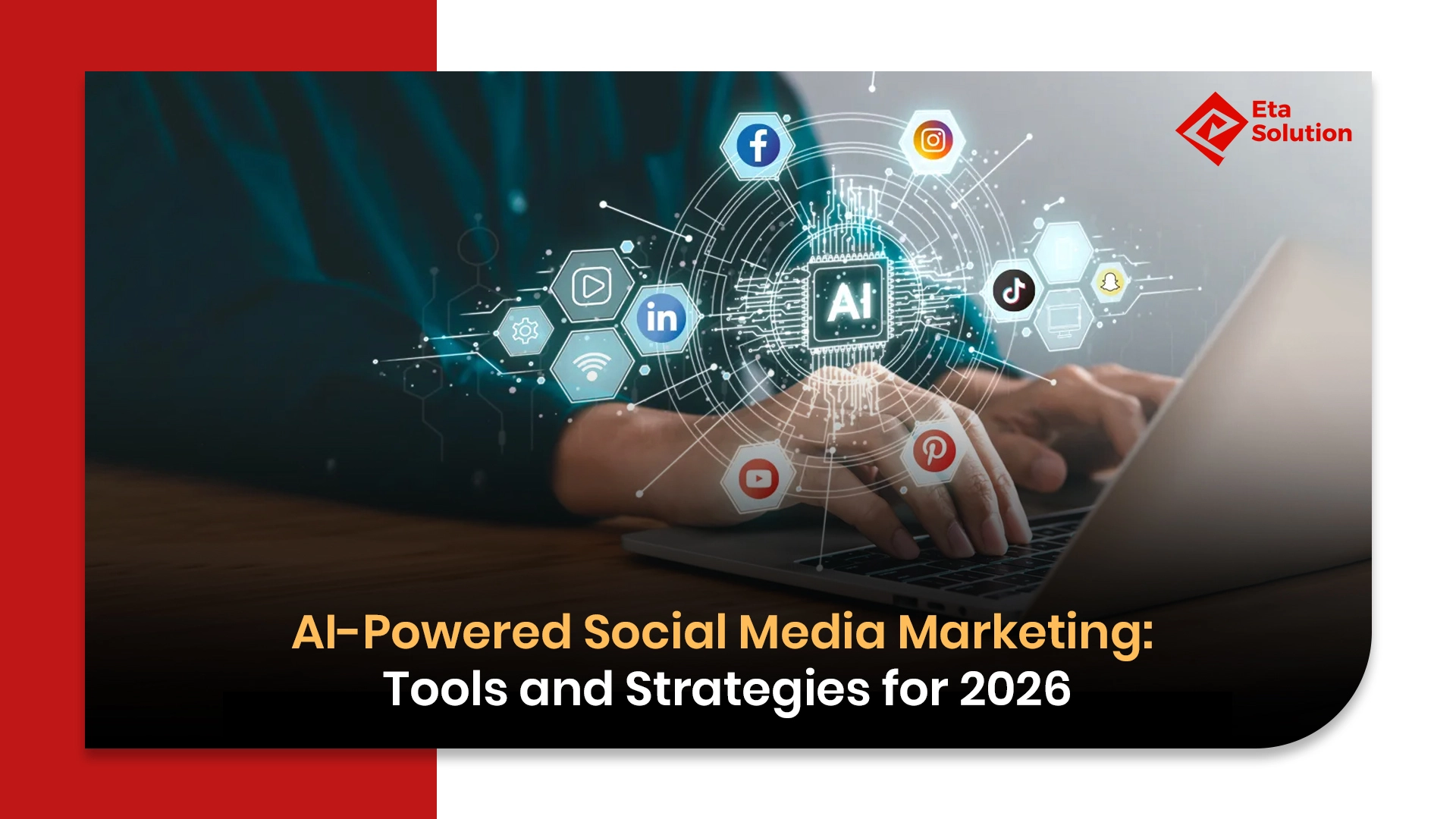
The Future of Social Media Marketing: AI Tools & Strategies for 2026
The social channels that your brand depended on for the last three years to get the same results are no longer operating in the same manner. The focus of users changes rapidly. Algorithms select the few that will succeed and put down everything else. The reach that is non-paid becomes smaller. The paid reach becomes more expensive. And one thing, amidst this madness, quietly, has become the stabilizer for top-performing brands: an AI-backed social media strategy.
Social departments at top companies will be fewer in number but more efficient and productive by 2026. They’re building always-on content engines, adapting to trends within hours, and optimizing campaigns without manual guesswork. This shift didn’t happen because marketers suddenly got superhuman. It happened because AI became their backbone.
Modern social media marketing isn’t just about posting consistently. It’s predicting behavior, designing high-performing content variations, auto-scheduling intelligently, benchmarking competitors in real time, and personalizing engagement. The organizations which are successfully changing over are those that look at AI as a strategic partner and not a solution that can be quickly fixed.
How AI Is Changing Social Media Marketing 2026
AI social media marketing in 2026 is radically different from what it was only a few years ago, when businesses just tried automation tools. The present systems are able to look for patterns to such an extent that even highly skilled strategists cannot find them by manual work.
Recent studies show that 71 percent of high-growth brands in the US now use AI-driven insights as their primary source for content decisions, not platform analytics dashboards. These insights include hidden engagement drivers, emotional tone patterns, competitor momentum shifts, and micro-trend cycles.
A major difference in 2026 is the way AI systems react in real time. If audience attention swings toward a rising topic, AI platforms can adapt content calendars instantly. If an ad set begins to fatigue, AI can detect the drop as early as 45 to 60 minutes before humans notice it.
This gives brands a measurable advantage in a race where timing dictates visibility.
Key Benefits of AI-Powered Social Media Tools
Relax! AI is not replacing marketers. It’s making social teams operate at the speed of platforms themselves.
Some practical benefits shaping social strategies this year include:
- Precision-level social media automation backed by contextual learning. These systems don’t repeat the same behaviors. They understand audience rhythm, seasonal variations, and how your niche responds to formats.
- AI analytics tools with predictive layers that reveal what type of content will gain traction before you publish it. The companies scaling fastest are the ones making fewer content mistakes.
- Real-time competitor intelligence that goes beyond surface-level benchmarking. AI observes sentiment swings, messaging frameworks, and pacing strategies across industry leaders.
Brands that hire the best social media marketing agency in Ahmedabad often look for teams already structured around these capabilities, because manually replicating this accuracy is no longer realistic.
AI Tools for Content Creation and Curation
AI content creation is now one of the most misunderstood areas in marketing. The intent is not to “generate posts.” The intent is to scale strategic thinking.
In 2026, top-performing brands use AI for:
- Content scoring at the draft level, where the tool evaluates the emotional tone, clarity, virality potential, and alignment with current audience behavior. This improves publishing accuracy dramatically.
- Micro-format generation, producing variations optimized for specific platforms without losing brand consistency. This is important because each social network’s algorithm favors different content structures.
- Curating industry-relevant content many hours before it trends within your circle. AI identifies rising themes not from virality but from sentiment build-up among early adopters. This makes brands appear well-informed and ahead of the curve.
These AI marketing tools help marketers operate as if they have an analyst, a script doctor, and a cultural researcher working silently behind the scenes.
AI for Social Media Scheduling and Automation
Automated social media scheduling was once a simple time-slot selection exercise. In 2026, it’s an adaptive workflow.
Instead of “best time to post,” AI looks at:
- Hour-by-hour sentiment shifts
- Emerging conversations relevant to your brand
- Ad inventory fluctuations
- Creator activity spikes
- Competing content saturation
If engagement drops due to external noise, automated scheduling tools delay posts. If audience activity unexpectedly peaks, the system moves the content up. These micro-adjustments prevent wastage of high-value assets.
Businesses that onboard the best social media marketing agency in Ahmedabad usually do so because they need teams capable of operating these intelligent automation layers.
AI Analytics: Measuring Social Media Performance
Predictive social media analytics is becoming the control center for many brands. Instead of waiting for campaign-end data, AI platforms provide continuous performance loops.
They answer questions like:
- Which content themes are expected to peak next month?
- At what point will an ad set lose cost efficiency?
- How is your share of voice shifting compared to industry leaders?
- Which audience segments are silently disengaging?
A lesser-known development is that many AI analytics tools now integrate with first-party CRM data, giving brands visibility into revenue-linked social behaviors. This alone has changed how CMOs measure the value of social.
Personalization and Customer Engagement with AI
Personalized marketing with AI is finally achieving what manual strategies couldn’t. Brands now serve content that adapts to user preferences without sounding robotic.
In 2026, AI-driven engagement systems analyze:
- User scroll-speed
- Time spent on creative elements
- Micro-reactions inside stories or short-form videos
- Content skip patterns
- Response time to comment prompts
These insights help build engagement funnels that mimic human-level intuition. This is why social media engagement AI systems are producing 30 to 55 percent higher interaction rates across sectors.
The standout shift is that personalization now happens at scale without fragmenting your brand voice.
Predictive Insights: Using AI to Anticipate Trends
AI trend prediction is the tool marketers didn’t know they needed until it became essential. Platforms now tap into billions of behavioral signals, creator-driven cues, and conversation clusters.
The real advantage is early visibility: Brands using predictive insights identify trend cycles three to eight days before they appear on competitors’ feeds.
This is how retail, fitness, and beauty brands in the US have been shaping their social voice ahead of major calendar moments. They weren’t reacting. They were preparing with data.
This same predictive layer is what many call the new foundation of a strong AI social media strategy.
AI in Paid Social Media Advertising
AI-powered social media ads operate much deeper than audience selection and creative testing.
In 2026, advertisers will use AI for:
- Dynamic creative mapping linked to sentiment data
- Cross-platform ad fatigue prediction
- Automated A/B testing with learning loops
- Real-time shift of spend across placements
- Conversion modeling when data visibility is restricted
One of the most interesting developments is that AI marketing platforms now detect “micro-conversion windows,” moments when your audience is most likely to act. This is based on behavioral bursts, not broad demographics.
Brands using this strategy see a reduction in costs by between 18 and 29 percent for their prospecting campaigns.
Best Practices and Moral Issues
Social media AI technology has been a vital element in a marketer’s arsenal, but using ethical AI in marketing is no longer a choice; it is an obligation. With the rising number of brands utilizing automation and personalization to their advantage, the onus is upon them to be clear about their activities and refrain from those that are offensive to users.
The foremost norms for 2026 are:
- Employ AI as an instrument to decide, not to influence consumer behavior.
- Respect for user limits is evolving into one of the main factors that distinguish companies.
- If AI is involved in a sensitive interaction, make it clear.
- Customers appreciate honesty, especially in service-based communication.
- Do not excessively personalize to the point that it seems the user is being surveilled.
After 2024, major brands decided to stop hyper-targeting as a result of the negative sentiment that was generated. Continue human judgment. AI is a great tool, but cultural nuances still belong to marketers.
These points show a brand’s maturity level rather than limiting its capability. Companies like the Best social media marketing agency in Ahmedabad often use ethical frameworks as part of their strategy to be prepared for the future.
Final Take
Social media in 2026 will work well for brands that can function fast, be aware of the situation, and use their brains. AI provides marketers with the means to understand the ever-changing feelings of the internet, change the content on the fly, and predict the outcomes with a level of accuracy that has never been seen before.
Nevertheless, the brands that will thrive in the future are not the ones that fully automate their operations. Rather, they are the ones who supplement human insight with the clarity provided by AI.
The question that leaders should be asking themselves at this point is straightforward: If your competitors are using AI to accelerate, what is actually slowing you down more – the danger in adopting it or the cost incurred by ignoring it?
AI-powered social media marketing uses artificial intelligence technologies such as machine learning, natural language processing, and predictive analytics to automate content creation, optimize posting schedules, analyze audience behavior, and improve campaign performance across social platforms.
By 2026, AI will enable hyper-personalized content, real-time audience targeting, advanced social listening, predictive trend analysis, and automated campaign optimization, allowing brands to make faster, data-driven marketing decisions with higher ROI.
Popular AI tools include AI-powered content generators, social media automation platforms, predictive analytics tools, chatbots, sentiment analysis tools, and AI-based ad optimization software designed to improve engagement and conversions.
Yes, AI can assist in generating captions, hashtags, images, short videos, and content ideas while ensuring brand consistency and platform-specific optimization. Human creativity combined with AI tools delivers the best results.
AI analyzes user behavior, interests, and engagement patterns to deliver highly targeted ads. It continuously optimizes ad creatives, audience segments, and bidding strategies to maximize performance and reduce ad spend waste.

What started as a passion for marketing years ago turned into a purposeful journey of helping businesses communicate in a way that truly connects. I’m Heta Dave, the Founder & CEO of Eta Marketing Solution! With a sharp focus on strategy and human-first marketing, I closely work with brands to help them stand out of the crowd and create something that lasts, not just in visibility, but in impact!
Top Digital Marketing Trends to Watch in 2026